Showing posts with label mobile barcode. Show all posts
Showing posts with label mobile barcode. Show all posts
Wednesday, April 02, 2008
Intel Sees Promise For Mobile Barcodes And Physical World Connection
From ZDNet Intel Reveals Its Vision For Mobile Phone Evolution
Intel has set its technicians working on a new initiative that it hopes will get mobile devices piggybacking on other devices its user may come across, as well as making use of the increasing number of sensors--such as cameras and GPS--within the device itself.
The terribly-named Carry Small Live Large plan is one of the company's "four or five big bets" for upcoming technology trends, with engineers working on new methods to use the applications available on mobile phones in ways that aren't dependent on the form factor of the device itself.
The Carry Small Live Large scheme is also looking at ways to utilize the data generated by the range of sensors included within mobile devices. According to Kahn, one of the oldest mobile sensors--the camera--has some of the greatest potential.
"That sensor could take a look at a barcode and give you information on the product, it could be connected to a database that you're looking at as a tourist", Kahn said. For example, by allowing the user to take a picture of a building in a foreign city, and using location information from the phone's GPS combined with the image taken by the camera-phone to find the building on a database and then deliver data on it back to the user's phone.


Sunday, December 23, 2007
Sprint Promotes ScanLife Mobile Bar Codes In Wired Magazine
A major U.S. wireless carrier, Sprint, is recognizing (and promoting) how big Physical World Connection (camera phone and barcodes) will be.
On page 35 of this month's Wired Magazine Sprint has a full page ad called "The Captivating Future Of The Bar Code".

Sprint is advertising ScanBuy's ScanLife mobile bar code reading application for camera phones.

ScanBuy was the first physical world connection company to land a carrier and major brand.
Notable quotes from the ad.
"not since the electric toothbrush has such an ordinary object emerged to make the the world a more nimble place"
"you are about to experience the life-altering future of the bar-code"
" we can't say for sure (no one can), but we have reason to believe .
"we have reason to believe that the bar code is going to revolutionize the way people consume things"
Sears, Billboard, Burn Magazine, Nike are just a few companies that are using ScanLife's mobile bar codes to link camera phones to the Net.
If you have a camera phone text "SCAN" to 70734 and download the free application, It takes less than a minute. supported phones
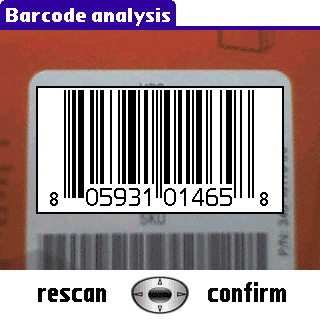
Take a picture of the bar code on the screen (or the magazine) and receive your secret prize. This poor image of the bar code, that was taken by a camera phone, can be scanned by the ScanLife application.
Tuesday, October 16, 2007
U.S. Patent Office Agrees To Re-Examine NeoMedia's Mobile Barcode Patent
In my opinion, this event could be the tipping point for mobile bar code adoption in the U.S.
NeoMedia Technologies, labeled a patent troll, has garnished quite a reputation in the Physical World Connection space.

In April 07, the Electronic Frontier Foundation (EFF) took aim at a bogus patent threatening innovative technologies that enhance consumer awareness, requesting a reexamination by the United States Patent and Trademark Office (PTO).
Due to clerical errors, the EFF had to refile the patent exam Request Of NeoMedia's "Bogus Patent".
On Oct 16, 2007 the U.S.Patent and Trade Mark Office ordered a re-examination of NeoMedia's patent.
To see the filing:
1) Go to http://portal.uspto.gov/external/portal/pair
2) Select "Control No." as the input
3) Enter 90/008779
I couldn't find this announcement on NeoMedia's website, but their latest financial filing outlines the risks to the company if this re-examination were to occur.
On October 15, the day before the Patent Office ordered the re-examination, the Chairman and member of NeoMedia's Board resignation became effective .
Monday, October 15, 2007
Global Standard Set For Mobile Barcode
From Wireless Week IATA Creates Mobile Barcode Standard

The International Air Transport Association (IATA), a trade body that represents 240 airlines and 94% of scheduled international travel, has reached an agreement on a global standard for mobile barcodes, which it says "paves the way" for air travelers to use mobile phones for check-in at airports.
Regional formatting differences has slowed down the deployment of mobile applications, though several airlines have adopted mobile barcodes for check- bin, there has not been a unified solution.
The IATA solution uses existing codes: Aztec and Datamatrix, which are used extensively in Europe and North America; and QR which is widely used in Japan. All three are proven technologies and can be read by a single scanner type that is available globally.
The association said it hopes to use the standard to begin working with members to develop standardized processes and guidelines to "facilitate global implementation."
The industry has set end of 2010 as the deadline to implement 100% barcoded boarding passes. The association estimates that once boarding passes are 100% barcoded, the industry could save more than $500 million annually
Monday, October 08, 2007
Thursday, September 20, 2007
Aeritas Reacquires Mobile Barcode Patent Portfolio And Becomes A Physical World Connection Player

From All Pay News Aeritas reacquires mobile barcode patent portfolio from GTech
With this mobile barcode patent portfolio, Aeritas is added to the Physical World Connection company list
Aeritas, the Mobile Barcode Company reacquired its extensive mobile barcode patent portfolio from GTECH Corporation, (a wholly-owned subsidiary of Lottomatica S.p.A., traded on the Italian Stock Exchange (LTO).
The Company's principals pioneered the mobile barcode and mobile ticketing space.
Aeritas' patents and technologies enable 1D and 2D barcode and other images to be displayed on the screens of mobile phones and handheld devices and used for a wide range of payment, mobile ticketing and other transactions.
Its patents, including many granted as well as several still pending in the U.S. and 30 other countries, cover a broad range of mobile applications.
The Company's patents and technologies encompass processes that enable 1D and 2D barcode and other images to be displayed on the screens of mobile devices and used for a wide range of payment, mobile ticketing and other transactions. (In my opinion, because a mobile barcode will/can be on various displays/items, these patents appear to have more value than just connecting the barcode to the net).
Aeritas' patents and technology encompass systems and methods that enable images, such as 1D and 2D barcodes, to be transmitted and displayed on the screens of mobile devices, including cell phones, PDAs, Blackberry and other handheld devices as well as laptop computers.
Aeritas' patented techniques, already in use, are revolutionizing new paperless transactions for sports, concert and event mobile ticketing, airline, train and bus tickets and boarding passes, mobile payments, retail coupons, prepayments and customer loyalty promotions, and a wide range of other uses.
Friday, June 29, 2007
China Uses 1D Barcodes For Physical World Connection
How does a business card in China disrupt Physical World Connection?
A consumer in China shows us how China is starting to use 1D barcodes on business cards. The ability to generate and scan a 1d barcode with a mobile phone has enormous implications.

CamClic allows anyone to create AND scan 1D barcodes (in addition to 2D codes) with a camera phone.
The CamClic solution has solved one of the biggest hurdles of Physical World Connection, scanning a 1d code with a mobile phone.
What does that really mean to advertisers, brands, search engines and consumers?
If the barcodes that are already on packaging can now be scanned with a mobile phone, and consumers can create their own 1d barcode, has the mobile code standard already been established?
There are over 3 billion unique barcodes. A 12 oz can of Coke has one, the 16 oz has another etc. While that 12 oz can of Coke has one physical world hyperlink, it represents millions of ways to directly connect a consumer to Coke.
Billions of individual items/brands represent trillions of physical world hyperlinks waiting to be connected to the Net.
Every product with a barcode, Coke cans, Fergie CDs, just need to be "turned on". Google can add over 3 billion pages of unique data to their index by assigning a URL (website) AND FUNCTIONS to a barcode. Functions could include (coupons, video, consumer report, warranty, tech support, reorder etc)
Do you think barcode owners could find uses for this? More importantly, would consumers?
The killer app for Mobile Advertising will be a portal/platform that can “turn on” AND create physical world hyperlinks.
I explained how Microsoft can beat Google this way.
Up until now, 1d codes have been kept in a closed network. Cashiers and stockboys scan a 1d code for product information and checkout. The information delivered FROM the barcode comes from servers inside the store network....(intranet).
You can also type in a UPC code into a search engine and get a general summary of the product and manufacturer.
What happens when Google, Apple or Microsoft introduce a mobile barcode scanning application that allows anyone to scan a barcode and be connected to the Net. This will open the network for trillions of objects.

How does a barcode threaten search engines?
The physical world hyperlink will now allow website owners to direct traffic to their site with a physical object rather than a search engine. A barcode on a product replaces "For more information visit our website". That’s what I call disruptive.
However, here's how Google connects the physical world
Great thought goes into the packaging of a product, but one thing is put on every package that brands have never been able to use before, until now. The barcode. Its universal, can be scanned/typed, doesn’t take up any more room on the product to market, and can now provide a direct connection w/ the Internet…a Physical World Hyperlink.
In their massive content land grab, would Google ever consider acquiring the UPC database? Would they need to if they could just link them using their "Google Click" mobile application?
Google thrives on acquiring and creating content, the other opportunity I see for Google with physical world hyperlinks is social networking.
Google could offer bloggers, website owners, MySpacers or their own social network site a chance to create their own 1D code (physical world hyperlink) . If both brands and consumers used this type of mobile code, wouldn't that make it the default "standard" for mobile code scanning?
CamClic now makes it possible to connect all items with a 1d barcode to the Internet using a mobile phone AND allows users to create their own physical world hyperlink. This will have a huge impact on advertising and social networking.
Comments, thoughts?
Monday, June 25, 2007
PowerMe Mobile Adopts Scanbuy's 2D Barcode Scanning Technology
Because DuPont, the world's largest consumer good packaging company licensed Scanbuy's interactive 2d barcode technology, and will be the exclusive marketer of their camera phone technology, I expect to see more companies adopt Scanbuy's 2d code scanning platform.
PowerMe Mobile Adopts Scanbuy's 2D Barcode Scanning Technology
PowerMeMobile, the Lebanese mobile solutions provider has signed an agreement with Scanbuy, Inc., a global provider of
 mobile marketing solutions, to market Scanbuy's two-dimensional (2D) barcode scanning technology in the Middle East and Africa.
The patented technology consists of a client application, called ScanLife,™ that is downloaded on mobile phones allowing the end user to read EZcodes, Scanbuy's patented 2D bar codes.
"Within the next 24 months we expect 2D barcodes to become ubiquitous as marketers and media deploy codes on products and marketing materials worldwide", said Jonathan Bulkeley, Chief Executive Officer of Scanbuy, Inc.
Bassam Tuéni, CEO of PowerMe Mobile, said: "We are proud to be associated with Scanbuy and its outstanding scan technology. We feel that it will enhance our solutions and offerings to the operators in the MENA region."
Recently PowerMe Mobile signed a content supply agreement with Universal Music Group, the world's largest music label. This could open the door to scanning all of Universal's physical items (Cds, movie posters etc) with a camera phone.
Thursday, June 21, 2007
2D Barcodes To Take Giant Leap Forward
Another respected technology publication realizing Physical World Connection is coming and highlighting one of the players.
From Guardian Unlimited Mobile Phone Hyperlinks For The Real World
The world of the so-called 2D barcode is nearly upon us. After several false dawns, hyperlinks for the physical world are becoming a reality, thanks to mobiles with higher resolution cameras and the emergence of 3G high-speed connectivity.
ScanBuy, a New York-based provider of 2D barcode capture technology, has signed a deal with Nokia to embed its software into the mobile manufacturer's S60 and S40 models - primarily in China, a country with 500m mobile phone users. And global packaging company DuPont is offering to print the codes on to its customers' products using ScanBuy's technology.

These more sophisticated versions of the traditional barcodes (universal product codes, or UPCs) used in retailing can be scanned by cameraphones and converted into text, images or video. They can simply contain information - up to 1MB in some cases - or act as web links, making the hitherto tricky process of surfing the net via mobile as easy as "point and click".
Barcelona-based Codilink is selling 20,000 2D barcode cinema tickets and discount vouchers a week, having licensed ScanBuy's technology. Codilink managing director Ben Chesser says: "Within one-and-a-half to two years, early adopters will be doing this regularly. It takes time to build awareness, but this technology is finally ready for take-off."
One drawback preventing widespread adoption has been the lack of standards in a fragmented and highly competitive mobile phone market. Few consumers have been bothered enough to download decoder software on to their phones.
The advantage of ScanBuy's proprietary software is that it can read any of the main barcode protocols, such as QR, mainly used in Japan; Data Matrix, mainly used in Europe; and EZcode, ScanBuy's code designed specifically for VGA cameraphones. And once more mobiles are shipped with decoder software built in, the mobile web will take a giant leap forward.
Tuesday, June 19, 2007
HookCode Uses Nextcode Mobile Barcodes To Connect MySpace, FaceBook And Beebo Users

A Nextcode angel investor has developed a new implementation using Nextcode's mCode format and ConnexTo decoder aimed at making it easy for social networkers to create Physical World Hyperlinks to their online profile.
Add HookCode and their application to the Physical World Connection company list .
MySpace, Beebo, and Facebook users now have an easy way to create mobile barcode for their website. HookCode has made it easy for real world, non-techie people to create a mobile barcode for their website. It also may get advertisers to come around to the idea that mobilecodes don't have to look industrial.

Using Nextcode's ConnexTo mobile barcode scanning platform, HookCode makes it easy for MySpace, Facebook and Bebo users to create a real-life web link to their user page.
No registration is required and your HookCode is created in 3 easy steps. The HookCode site is in early stages of implementation (SMS delivery of the codes to users phones so they can run as a wallpaper on the phone) but the Nextcode team wanted to let Pondering Primate readers have a sneak peak and get reaction. Their effort here is to show how easy code creation can be and to evangelize codes to the social networking, under 25 yr old group. They probably wouldn't mind if a few brands or social networking sites grasped the possibilities either....
HookCode looked at lots of different code formats and found that Nextcode Corporation's unique mCode format was the best by far. mCode and the ConnexTo decoder were engineered for mobile phone optics. What does that mean to you? They work dependably. With other codes, you have to hold the camera just right, in the right light, because they were made to be scanned by that laser thing at the grocery store - not your mobile phone!
MySpace user Nicole used the HookCode widget to create a HookCode for her site and post it on her MySpace page. Take a look at her MySpace site that uses a HookCode.

FROM THE HOOKCODE SITE:
Here's how it happened: We got sick of tapping people's MySpace address into our phones to check them out online. Or worse, writing iton a napkin, and then trying to read it after it went through the wash.
Using Nextcode's ConnexTo mobile barcode scanning platform, HookCode makes it easy for MySpace, Facebook and Bebo users to create a real-life web link to their user page.
HookCode has made it so easy to create a code for your site. HookCode's easily identifiable codes will allow quick adoption and scanning among users.
Snap a pic of a HookCode and go straight to a MySpace profile or anywhere else. Nextcode Corporation's unique mCode format were engineered for mobile phone optics. What does that mean to you? They work dependably. With other codes, you have to hold the camera just right, in the right light, because they were made to be scanned by that laser thing in the gorcery store-not your mobile phone!
How do you get a HookCode?
Click Here and enter your web address. It's that easy.
To get your HookCode reader go to http://www.wap.connexto.com/
Let HookCode know how you use your HookCode. Send them an email and they will post your idea on their site. The coolest HookCodes will get a HookCode tshirt.
HookCodes generated by ConnexTo
Write Reviews On Products Using Barcode And Mobile Phone
Orange County Register has a story titled Cell-phone Secrets that discusses an indirect Physical World Connection application. Mobile phone users can enter a product's barcode to get reviews of a product.
You're walking through the grocery store, Web-enabled cell phone in hand. You wonder, is that gallon of organic milk really environmentally friendly?
Your cell phone can help answer that question, with information from GreenScanner.net.
If you point your mobile browser to that site and type in the product code for Horizon Organic 1% Milk (UPC Code 742365264108), you'll tap into a database of environmentally focused consumer comments. For Horizon 1% milk, the overall rating is fairly good – 3.57 out of 5 – based on comments such as "better for people and cows too – fewer pesticides, etc." and "Locally-grown food is the best way to go."
The system still has many shortcomings, starting with its cumbersome requirement for entering UPC codes. In the future, consumers may be able to access GreenScanner data by taking a cell-phone photo of a product's bar code.
The beauty of this application is that it lets consumers provide the input on products. I guess it could be called a Barcode Wikipedia.
I can think of lots of applications that could be introduced using the UPC database:
For consumer goods a "Consumer Reports" application could be introduced.
For fun I added comments to Coke's new Enviga Green Tea.
Have a comment on a product? Post a comment at Green Scanner and let PP readers know.
You're walking through the grocery store, Web-enabled cell phone in hand. You wonder, is that gallon of organic milk really environmentally friendly?
Your cell phone can help answer that question, with information from GreenScanner.net.
If you point your mobile browser to that site and type in the product code for Horizon Organic 1% Milk (UPC Code 742365264108), you'll tap into a database of environmentally focused consumer comments. For Horizon 1% milk, the overall rating is fairly good – 3.57 out of 5 – based on comments such as "better for people and cows too – fewer pesticides, etc." and "Locally-grown food is the best way to go."
The system still has many shortcomings, starting with its cumbersome requirement for entering UPC codes. In the future, consumers may be able to access GreenScanner data by taking a cell-phone photo of a product's bar code.
The beauty of this application is that it lets consumers provide the input on products. I guess it could be called a Barcode Wikipedia.
I can think of lots of applications that could be introduced using the UPC database:
For consumer goods a "Consumer Reports" application could be introduced.
For fun I added comments to Coke's new Enviga Green Tea.
Have a comment on a product? Post a comment at Green Scanner and let PP readers know.
Thursday, June 07, 2007
Barcodes And Physical World Connection Could Transform Ad Industry
Adotas has a nice summary on how barcodes (physical world hyperlinks,) when scanned with a camera phone, (Physical World Connection) have the ability to transform the ad industry.
The article discusses what could happen when special barcodes (2D codes) are used as links to more info about products. Although the data contained in the barcode ALREADY on the products contains less info, it too will be used as a link to the Internet.
The Humble Barcode Could Change The Ad Industry

"One particularly interesting technology already gaining considerable traction in the Far East is the use of barcodes that enable mobile phones to interact directly with every day objects.
The premise is simple – people use the cameras on their mobile phones to read encoded information via barcodes. These new types of barcodes (2D codes) can hold a far greater depth of data than the barcodes we’re used to seeing on every day objects today. Once scanned, software built into mobile phones can translate the information into content ranging from text and images through to video clips.
For direct response advertisers this could have a major impact. Instead of being restricted to the inclusion of 1 800 numbers and URLs, offline ads could start to evolve into far more powerful pull marketing tools."
Thursday, May 17, 2007
EverMobile Sees Revenue Impact From Mobile Barcodes
Is this the first carrier (outside of Japan), commenting on Physical World Connection revenues?
From TMCNet EverMobile: 10% of Revs Likely From Scanning Solutions In 2008"
Brazilian mobile payment solutions provider EverMobile believes scanning applications have potential to account for 10% of its revenues in 2008, EverMobile business development manager Sergio Goldstein told BNamericas.
Today EverMobile gains 100% of its revenues from financial solutions for cell phones, but it recently established a partnership with US solutions provider Scanbuy , whose software transforms cell phones into barcode scanners via the inbuilt camera.
In Brazil there are about 15mn handsets with cameras, or 20% of the market, and the number is growing, Goldstein said.
EverMobile aims to launch the applications in the third quarter of 2007 in Brazil and Goldstein believes three of the country's main mobile operators could sign up for the solution by year-end.
Friday, May 11, 2007
Firefox Mobile Barcode Provides Physical World Hyperlinks Online
Firefox provides a mobile "Do"-main.
How long before Google, Yahoo, Verisign (websites) and any advertiser introduce an application that generates a 2D code for any URL?
Consumer packaging will soon have 2d codes that can be scanned by mobile phones. A 2d code (Physical World Hyperlink) standard is being created.
Will there be a big desire for a proprietary code reading application? Where will big advertisers/brands focus their efforts?
360 Mobile finds the Firefox extension that will display a mobile code for the URL of the current site, called Mobile Barcoder

This extension generates 2D barcodes (called QR Codes) of the URL of the current page being viewed. You can then use a mobile phone to read the URL from the screen to save you typing the long URL using the phone keypad.
Once you move the mouse over the text “Barcode” the mobile code for the current URL pops up as shown here.
I think this shows how easy it is to create a 2d (physical world hyperlink PWH) and that it is just a commodity. Value from Physical World Connection will come when any mobile device can scan the hyperlink and be connected to relevant and timely information (database).
Various high traffic websites will offer 2d code producing capability as easy as Firefox does, and DuPont will be printing 2d codes on consumer packaging.
Both the physical world and electronic world are now generating physical world hyperlinks.
Tuesday, April 10, 2007
Telefonica Espana Adopts Scanbuy's Mobile Barcode Platform
The largest wireless operator in Spain adopts Scanbuy's physical world connection platform.
From CBS Marketwatch Scanbuy and Telefonica Espana launch mobile barcode solution
Scanbuy, Inc., a global provider of wireless commerce solutions, today announced the completion of its mobile barcode platform created for Telefonica Moviles Espana , the largest wireless operator in Spain (TME).
The platform is the first of its kind in Europe to combine multiple uses of barcodes on mobile handsets.
Scanbuy's platform supports TME's strategy to facilitate access to mobile content and use of the handset as a transaction device for its 21.5 million subscribers and will be the first integrated platform combining couponing/ticketing and print-to-mobile. Atos Origin , an international information technology services provider, has been selected to provide systems integration and project management services to bring the solution to market.
By selecting Scanbuy's mobile barcode technology, TME will offer its Movistar subscribers access to content by simply pointing their camera phone at a two-dimensional barcode, to be found in advertising, on TV, business cards or websites. Scanbuy's client application ensures quick and easy access to online data and multimedia services from a wide range of handsets. Scanbuy's service platform will allow content providers to create, manage, and monitor their barcodes and to launch couponing and ticketing campaigns by sending barcodes within SMS or MMS.
"Being selected by Telefonica Moviles Espana, the leading mobile operator in Spain, is not only proof of Scanbuy's best of breed mobile barcode technology but it also positions Scanbuy as the global industry leader," said Jonathan Bulkeley, Chief Executive Officer of Scanbuy, Inc.
From CBS Marketwatch Scanbuy and Telefonica Espana launch mobile barcode solution

Scanbuy, Inc., a global provider of wireless commerce solutions, today announced the completion of its mobile barcode platform created for Telefonica Moviles Espana , the largest wireless operator in Spain (TME).
The platform is the first of its kind in Europe to combine multiple uses of barcodes on mobile handsets.
Scanbuy's platform supports TME's strategy to facilitate access to mobile content and use of the handset as a transaction device for its 21.5 million subscribers and will be the first integrated platform combining couponing/ticketing and print-to-mobile. Atos Origin , an international information technology services provider, has been selected to provide systems integration and project management services to bring the solution to market.
By selecting Scanbuy's mobile barcode technology, TME will offer its Movistar subscribers access to content by simply pointing their camera phone at a two-dimensional barcode, to be found in advertising, on TV, business cards or websites. Scanbuy's client application ensures quick and easy access to online data and multimedia services from a wide range of handsets. Scanbuy's service platform will allow content providers to create, manage, and monitor their barcodes and to launch couponing and ticketing campaigns by sending barcodes within SMS or MMS.
"Being selected by Telefonica Moviles Espana, the leading mobile operator in Spain, is not only proof of Scanbuy's best of breed mobile barcode technology but it also positions Scanbuy as the global industry leader," said Jonathan Bulkeley, Chief Executive Officer of Scanbuy, Inc.
Wednesday, April 04, 2007
Physical World Connection Summary At CTIA 2007
The CTIA show is always informative in many ways. There are press releases for new products, new(games, search engines, email apps) and numerous companies exhibiting the "next thing" in mobile. My focus is on mobile phones connecting the physical world to the Internet through physical world hyperlinks (PWH).
I have often found the key developments are discovered off the main showroom floor though.
The easiest way to find out what is really happening in this space (and I encourage going to CTIA for this reason) is to talk to the companies that will or can adopt this technology. It is becoming clear which Physical World Connection (PWC) companies are getting their platforms adopted, and who is still trying to get traction.

I saw all of the PWC companies on my PWC list that were there at the show, and discovered a couple new ones that I will be adding shortly.
Last week I saw a 1d code (barcode) scanning solution for camera phones that doesn't require any special lens attachment and works on major handsets. In addition, this application can read 2d codes as well. This solution could play a key role in the Physical World Connection space.
More on this company later.
In my opinion, the 2nd quarter of 2007 will be the tipping point for Physical World Connection adoption in Europe. One major wireless carrier has already embedded a PWC platform. Two additional major carriers should be announcing a PWC platform adoption shortly as well.
I had the chance to see some pretty exciting upcoming 2d code mobile marketing campaigns. These campaigns include scanning codes on various objects for videos, coupons, and a host of other permission based marketing. The brands using physical world hyperlinks (PWH) is impressive.
One of the biggest reality shows will be incorporating PWH into their upcoming season. This campaign and the PWH become part of the show and could be a terrific way to educate consumers on PWC. I can see how a brand could piggyback just one show and one PHW into a major campaign.
A major recording star is incorporating PWH into a campaign for their next album.
One PWC is finding a way to utilize a captive audience and incorporate their platform. Many will say "why didn't we think of that?".
Microsoft throwing their hat in the PWC ring is shaking up things a bit too. There were some interesting comments from the carriers and PWC cos about this.
2006 was a year some of the PWC players would like to forget too. Players in the space will know what event I am referring to.
Probably the two biggest developments I came away with at CTIA are:
1. a company with a 1d code (and 2d code) scanning application that is still in stealth mode
2. the impact DuPont and their 2d code announcement is having on the Physical World Connection space.
These two developments could allow all existing consumer goods and newly created consumer goods (packaging) to be connected to the Internet.
The figures for Internet advertising only continue to grow, and companies that measure clicks/ traffic on ads are being courted. I wonder what value will be place on a permission based marketing solution that can deliver ads/content directly to a mobile phone when the consumer is holding their product in hand?
There are lots of Physical World Connection opportunities for companies or individuals with vision
Wednesday, June 29, 2005
Physical World Connection Companies..Connecting A Mobile Phone With A Physical Object
When a display was added to the first mobile phone, a new media was created. Since then, Internet connection and a camera have been added that have created a new way to interact with the physical world.
Soon speech recognition will allow an additional way to browse the physical world too.
Every physical object will have a physical world hyperlink
That means every physical object will allow connection to a designated website and the mobile phone with it's physical world browser will be able to surf the "real world", the physical one.
I think you find THE NEXT GOOGLE in here.
Your ad could be here.
MOBILE BAR CODE COMPANIES
23half and their Thrrum Visual Browser
3GVision
5o9 Inc
Abaxia and their MobileTag
ABBYY
Active Print (Hewlett-Packard)
ActiveSymbols
Aeritas
Airclic
AlpsLab
Applied Digital Solutions and their VeriChip
Aura Interactive
Baracoda
BaToo
BeeTagg
BluePulse
BrandAttention
CamClic
[COD]mmunication
ColorZip Media
ConvergeLabs
CounterFight
DSPV
Daem Interactive
Denim Code
DiMoCo
Digimarc
Domino Solutions
Ecrio
Elcode
Evolution ViPR
Evryx
Exbiblio
G2Tactics
Gavitec
GenTag
GeoVector
GMedia
Google 2D Code
Google Voice
Hitachi
HookCode
Hypertag
Iconlab
Infokall
Innofone
Intelcom
Intellareturn's Append
Intrasonics
JagTag
Jaxo and their BarShow application
Kameleon
KoolTag
L.G. Electronics
Liquid Information
Luna Development
MBarc
M-Bar-Go
Matrix Solutions
MediaSeek
Mobicode
MobileAMA
Mobile Assets Corp
Hewlett Packard'sMobile Bristol
Mobile Discovery
Mobile Tag
Mobile2Win
MobilRelay
MobiMarketing
Mobot
Mobiqa
MyBestPrice
MyClick
MyMobileCast.com
Mytago
MyThum Interactive
NetInformer
Nextcode
Neven Vision
NewFound
NPCTelecom
nThrum
Nuance
Ontela
Kooaba and ooLink
OP3 and ShotCode
Opera
PaperDisk
PixeCode
PriceNoia
Psiloc
QuickMark
QMCODES
RealEyes 3D
Riya
SCANBUY
Scansoft/SpeechWorks
Secure Symbology
Semacode
Semapedia
Sintef
Skuair
SmartPox
SnapTell
Socket
SpyderLynk
SwiftPass
Tagit
TellMe
Trillcode
Tripletail Ventures and their VideoBarcode
Veritec
Tivik
Visual Magic
Vocalocity
VoiceGenie
VoxSurf
w3 Logistics Handyscan
Wappple
WideRay
Xerox
Xobile's Leapscan
XXTreme Measures
ZapCode
ZapLinks
List is not complete due to some companies wishing to remain private about their applications
If your company is not included, please send an email and I will be happy to include in this category.
Wouldn't your ad look good here?
Subscribe to:
Posts (Atom)