Thursday, September 21, 2006

What Is Disruptive Technology?

This months Business 2.0 Magazine has both and editorial and story that defines disruption and lists some of "The Next Disruptors".

One of the many reasons to subscribe to this informative magazine.


As Josh Quittner at Business2.com states "If necessity is invention's mother, disruption is its father. Disruptive changes- in technology, consumer behavior, and the ways businesses are run-can unleash creative energies that were held back by the status quo"

"One of the definitions of disruption is not that it displaces someone else but that it opens up new markets that werent being addressed before".
The story goes on to state "Disruptive technologies. Almost no one fully comprehends what a shock to the existing order they represent until well after the rattling has begun".

At Visionary Innovations , we share the passion for disruptive thinking. We look for companies and/or technologies that have the ability to either disrupt a current industry/technology or establish a new one.

The most innovative thinking can lead to very disruptive applications.

Let me know if there's technology or a company that you feel is truly disruptive

Wednesday, September 20, 2006

Procter And Gamble Uses Amp'd For Mobile Campaign


Congrats to the guys at Amp'd Mobile for landing this Gorilla.


P&G's advertising goes wireless

Proctor and Gamble, the largest U.S. advertiser, will be advertising its Herbal Essences shampoo on Amp'd Mobile .


The move gives a huge boost to mobile video as a viable advertising channel, and it gives P&G access to 50,000 Amp'd subscribers, Advertising Age reports. P&G has purchased 15- and 30-second spots that will begin appearing Amp'd's mobile video channels in October.

Beginning next year, Amp'd will offer discounts to subscribers that opt-in to providing their age, gender, and location

Digimarc Offers Physical World Connection

Digimarc adds their own digital watermarking solutions to printed materials, and creates their own physical world hyperlinks.

Digimarc and Mobile Data offer print-to web applications

Digimarc Corporation today announced an agreement with Mobile Data Solutions Inc. to bring new consumer-oriented mobile applications and experiences based on Digimarc Mobile print-to-web linking technology to the U.S. marketplace

Under the agreement, Mobile Data Systems will license and use the Digimarc Mobile platform to market a number of innovative mobile consumer applications that allow camera phone users to automatically link from printed materials, such as catalogs, magazine advertisements, and packaging, to associated sites and services on the Internet.

"We are excited by the potential of the Digimarc Mobile platform to bridge the physical and mobile worlds and envision a variety of innovative and practical applications that will benefit mobile consumers," said Anthony Iacovone, vice president of business development at Mobile Data Systems

Texas Instruments Sees PWC For Product Authentication

I envision pharmaceticals and high-value goods having some type of RFID tag(visible or not), that when scanned with a mobile device, will be authenticated in some protected database.

This is another example of physical world connection.

Texas Instruments advocates RFID authentication

While Texas Instruments is talking about this industry, there's another chip player that is providing an all-in-one solution.

With counterfeiting estimated to be a $450 billion industry worldwide, the need to protect product and brand integrity is set to become the new value proposition for RFID, according to a new white paper from Texas Instruments Incorporated.

RFID fights counterfeiting with an embedded electronic security marker, identifying a product or brand, that is automatically read as it passes through the supply chain either individually or as a group inside a shipping case.

An electronic security marker is a unique data code that by itself or in conjunction with a network, can distinguish the product as genuine. This marker is unique to the individual product and cannot be easily altered, providing an enhanced level of security.

2d codes are being used to help this problem, but secure database issues are a problem with this method. The key components are a "tag" that is either invisible or cannot be altered, and a secure database.

Ernst And Young Recognizes Physical World Connection

It is nice to see the "innovaters" talking about physical world connection.

Aner Ravon participated in this year's "Journey" by Ernst and Young. The topic was The Future of Mobile Applications.

One of his two future directions.

I do believe that in not so long, I will be able to flag a product a like, scan it’s barcode (or RFID) with the phone’s camera, get multiple price offers directly at my phone, pick one and have it delivered with a click of a button. (I agree on the scanning part, but I think 2d codes and RFID tags will play a bigger role than a 1d code)

Oh yeah, I will also get a discount from my operator for making a purchase and settling it through my phone bill.

Zigbee Plays Role With Universal Remote

Cell phone users in Italy will soon have access to some of the newest functionality to be incorporated into handsets, including remote control capabilities and electronic wallets, courtesy of Zigbee

Carrier Telecom Italia is marrying together handset SIM cards with the short-range, low-power, mesh networking standard Zigbee.

Freescale has also been working on including Zigbee in cell phones.

Telecom Italia looked at a couple other wireless technologies to serve the same purpose, including RFID and Bluetooth. But eventually the carrier settled on Zigbee for its higher level of security and because it could be included on the SIM card itself and did not require a separate reader as RFIDs do

Tuesday, September 19, 2006

RFID Tags Offer Mobile Ads

This isn't scanning a physical world hyperlink, but it does use a PWH to deliver relevant information.

Wireless World Japan has an interesting post about NTT DoCoMo using RFID tags to predict consumer behavior and deliver targeted mobile marketing messages.

I said a few days ago, the smart brands are already figuring out how to use RFID tags as an interactive tool for advertising.

My first thought about this service is how will advertisers get the consumer's permission to deliver these ads. What will be enticing enough for people to opt-in to this service?

If they do get consumers' permission though, this could a fantastic tool for advertising. Spontaneous, relevant, location based advertising.

As the consumer visits various shops and locations, their mobile sends RFID tags to a server. The server than runs software to predict what the consumer is doing and sends them information relevant to their situation. In an example provided by DoCoMo, a consumer who is searching for a pair of shoes visits shoe shops A, B and C. The server guesses that this is what the consumer is doing on the basis of the RFID tags it receives from shops A, B and C and then sends the consumer special offers from shop D which they have yet to visit.

Eventually I can see Shop D, or a "Moogle"(mobile Froogle) alerting the consumer of a cheaper price when they pick up a specific product. Then you will have ecommerce sites participate and offer an even cheaper price if you buy online through your mobile.

DoCoMo is currently testing this system out in a single shopping mall.

Monday, September 18, 2006

Barcodes...Scanned Or Phasing Out?

Symbol Technologies putting itself up for sale , has got me pondering. I realize RFID tags will eventually replace the barcode, but did this announcement speed things up a bit?

Are we seeing the beginning of the end for the 1d code (barcode)?
Scott Shaffer
Symbol, known as the pioneer of the barcode industry, acquired RFID pioneer Matrics in 2004 to ready itself for the next wave of identification technologies .

Instead of becoming another “Kodak” or "Xerox", Symbol Technologies saw change and adapted. Will Physical World Connection (PWC) companies recognize this and do the same?

This is already happening in the Physical World Connection (PWC) space.
As I see more 2d code players enter the physical world space, it appears to me that the 1d code (barcode) is being passed over. I recognize a shift in the PWC is occurring.

More companies are focusing on using a 2d code or an RFID tag (in various forms) to connect to the Internet than a 1d code.

The three physical world hyperlink contenders (right now) are an RFID tag, a 2d code and a 1d code. 2 of them are just starting to be implemented, the other is being phased out.

Think of the biggest industries and the companies in them, what PWH will benefit them the most because that’s where the money will go.

The major phone manufacturers are already producing phones that can scan a 2d code and an RFID tag. Where does that leave the 1d code space?

Would you create a business or application around a technology that is being phased out, or being implemented?

Somewhere I am sure there are creative ideas floating about for the VHS tape too, but would any legitimate banker provide financing for them?

Like Symbol Technologies, will PWC players create applications that include all types of RFID tags?

The transformation is already occurring.

Sunday, September 17, 2006

Symbol Technologies For Sale

An interesting and telling week for the barcode scanning industry. What does this say about the companies in it?

Metrologic is going private and now Symbol is selling itself .

My first thoughts are that Symbol realizes that the RFID industry will eclipse barcodes, and that Motorola makes a mobile device that can read them.

Symbol Technologies Inc. , a maker of bar code and inventory scanning technology, is auctioning itself, and mobile phone company Motorola Inc. is the most likely buyer, the Wall Street Journal reported on Saturday.

Symbol, based in Holtsville, New York, makes bar code scanners such as those found in supermarkets. It also makes radio-frequency identification tags that store information in tiny microchips and can be scanned to track inventory

QuickMark A Physical World Connection Player

Add Quickmark to the physical world connection list

Create your own physical world hyperlink (2d code) with QuickMark and connect to the Internet with a camera phone.

QuickMark is an open architecture 2-D barcode application platform.

The number of companies offering free 2d code applications is growing pretty quickly.

Why would anyone pay for a 2d code when they can be created for free AND control where they want the user to go?

In the future, name card of everybody will have their own bar code, which could direct scan via the camera phones.

(This is one of reasons why PWC companies need to let consumers create their own 2d code if they want their application to get traction).

With the camera phones with QuickMark installed, just need to scan the barcode, the encode bar code will decode by the QuickMark decoder and then shown the information stored in barcode.


QuickMark is a low cost killer application in m-commerce territory. Neither special high-grade cell-phone nor pre-pay are all un-necessary.

Users can download QuickMark software from http://www.quickmark.com/tw free for support phones.

Generate your own 2d code

See how it works

I see Yahoo or Verisign introducing this same application shortly. Any domain registry service should offer a free 2d code with a ".mobi" registration. In my opinion, Google and others will eventually introduce a 2d code registration and start a "click-to-call" advertising service.

Who's platform gets adopted first or by the biggest audience?

I think any company that can either get their code scanning application on a popular "teen" phone, a company with a high volume Internet portal, or a company that introduces some "must have" tool for their phone and it uses their 2d codes.

I don't see mass adoption coming from advertising incentives.

Saturday, September 16, 2006

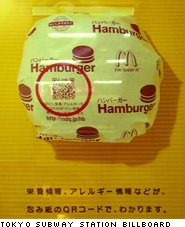
McDonald's Connects Physical World With QR Codes

The largest wireless carrier, mobile phone manuf, search engine and now the largest restaurant chain in the world are using QR (quick response) codes.

Why is one of the largest retailing companies, that has the ability to print a 1d code on anything, using QR codes instead of the regular 1d barcode?

If they aren't using a 1d code, what makes you think other major corporations/brands will?

How long before McDonald's and their cross marketing clients, will start to use these 2d codes for advertising and to interact with the consumer in revenue producing way.

I can see the music and movie industry ideas already.

From Calorie Lab QR codes offer information at McDonald's

McDonald’s is now placing codes on the packaging of many foods so that eaters can scan the package with their cell phones and find out the nutritional information.

Notice they are using these codes to provide information to the consumer and not trying to advertise to them yet.

Scanning the QR Code on any of 19 sandwiches, eight sides and five salads brings up a URL, which will take customers to the nutritional information for the food they are eating.

This is something I could see the States mandating when camera phones with 2d code readers are common.

Friday, September 15, 2006

Mytago Lets You Connect Physical World With Mobile Phone

Add Mytago to the Physical World Connection list .

See how fast this list is growing? It can only expedite the "Internet of Things".

As I stated earlier, there are/will be many ways to connect the physical world with the Internet using a mobile phone.
PWC companies that allow the individual to create their own 2d code should stand a better chance of getting traction.

Mytago tags works like common barcodes but instead of the barcode scanner, you scan tags by taking a snapshot with your phone camera. Use the Mytago tags with your own logo and color themes as bookmarks, that can be scanned by mobile phone camera.

You can use Mytago with regular snapshot images also. Take a snapshot of any text information from a flyer or poster using mobile phone camera and Mytago can help you read the text data.
Take a snapshot image of anything you want to share or as a reminder to yourself. Mytago helps you share it by email, upload to Flickr (see the possibilities here?) or link to your blog or website.

The cellphone is used only to capture snapshots of tags, images or text data. All user interaction is done on your familair PC web browser when you go online.

The Mytago tags can be used to promote an event you are planning, like on a garage sale flyer or poster. Or put it on your busines card, billboard or a bumper sticker. Use your imagination and find your own unique ways to use Mytago tags.

Great find Exbiblio

Thursday, September 14, 2006

A New Physical World Hyperlink, FP Codes

Jan Kuczynski at Wireless World discovers FP codes, a new physical world hyperlink from Fujitsu.

Fujistsu's FP Codes can be added to the physical world hyperlink category

Today, Fujitsu announced the FP code or Fine Picture code, a technology which embeds codes into pictures in a way that’s difficult for the human eye to spot.


The FP codes won't alter the picture/packaging, but how will you know they are there? Could this be something for the authenticity market?

The key point from this is that ANOTHER type of physical world hyperlink is being created which will allow faster adoption of the "Internet of Things".

Create Your Own Mobile Barcode With Scanbuy

What do Scanbuy and Nextcode have in common? Why are their applications gaining traction first?

Both Scanbuy and Nextcode ALSO allow consumers to create their own 2d codes rather than rely on the ones advertisers provide.

Some of the most useful Internet applications have come from creative thinking and open code applications.

Scanbuy introduces scanLIFE and their EZcodes.
EZcode is very much similar to any other barcode you will find on books or CDs. It differs from those barcodes in the sense that this falls in the category of 2 dimensional barcodes and is much easier to be decoded by your mobile phone camera.

The mapping of content related to a barcode is done based on the unique ID. You can attach any type of content to it. scanLIFE decodes the EZcode and access the content attached to it.

Penny-size EZcodes can be captured by VGA camera phones, even in low light environments.

Supported phones


Create your own EZCode today here

On a side note, Jonathan Bulkeley was added to Spark Networks Board of Directors today.
Can you see how EZCode could be used here?

China Mobile Offers QR Codes For "Mobile" Campaign

From Pacific Epoch China Mobile uses barcode for train ticketing

China Mobile plans to test a train ticketing system using its bar code e-commerce service QRcode in Beijing in October, reports National Business Daily. With the correct handset QRcode, users can get on trains without having paper tickets.

Just last month China Mobile hooked up with Google and Nokia to provide a physical world connection application.

By placing QR codes on billboards next to train platforms, inside the trains and in local newspapers you have a "captive audience" to interact with.

How long before Google introduces a 2d code creating application for advertisers and mobile users?

Nobody answered my question yesterday "Who has an ecommerce and shipping platform and just added a telecom infrastructure?" correctly.

You will find a clue here

See how the physical world connection platform is being built?

Wednesday, September 13, 2006

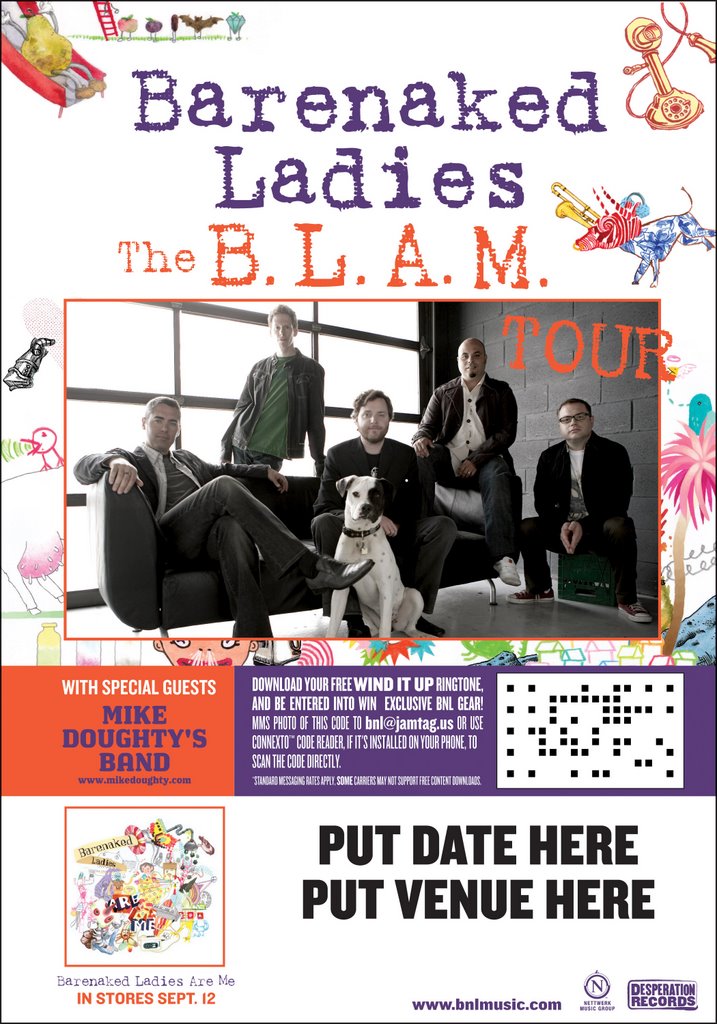
Nextcode's mCode And Barenaked Ladies

This 2d code scanning mobile marketing campaign is more than just selling albums, it's introducing a way for record labels and musicians to interact with their audience.

This is the poster iLoopMobile is using for their Barenaked Ladies mobile marketing campaign. Click on the poster and in the bottom right corner you can see Nextcode's mCode.


Why did Terry McBride and Nettwerk Music Group hook up with iLoop? Why is iLoop using barcode scanning from Nextcode? click here

McBride, the company's cofounder and creative force, is quietly carrying out a plan to reinvent the music industry, including legalizing file-sharing and giving artists control over their own intellectual property.

He's also introducing the physical world connection application to the perfect demographic in an environment will allow rapid adoption.

Eventually McBride would like to pioneer another source of revenue with even greater potential, P2P networks.

Where do you think you would find the biggest audience for P2P networks? MySpace.

Nextcode Uses Mobile Phones And Barcodes To Connect Barenaked Ladies

I have to believe a mobile marketing campaign with this band and MySpace can get "legs".

Nextcode is one of the physical world connection (PWC) companies that understands how consumers will adopt this exciting technology.

From BusWire Barenaked Ladies use 2d code camera phone technology

iLoop Mobile , a leader in mobile application software, today announced that Nettwerk Music Group, Canada's leading privately owned record label and artist management group, has selected iLoop Mobile to create and deploy e-commerce mobile internet sites using Nextcode's mCode(TM).

The hit band Barenaked Ladies will be the first to use the technology with their new album.

An optical code (2d code) will be placed on tour posters and advertising that can trigger the Barenaked Ladies' mobile Internet site to deliver free and paid mobile content.

Partnering with Nextcode , iLoop Mobile will offer the latest in mobile marketing by replacing a shortcode with an optical image to launch the Barenaked Ladies' mobile internet site

What PP readers should also know is that Nettwerk Music Group works very close with MySpace.

I wouldn't be surprised to see more of Nextcode's mCode be included in other mobile campaigns involving MySpace. Can you see how quickly this can get adopted now?

How do you get a code scanning application on the camera phone and create a viral marketing campaign?

Combine a hot band with the largest online community and throw in a 2d code that most camera phones can use.

It is this kind of creative thinking that will separate the physical world connection players.

PWC Player Metrologic Goes Private

This is one of the companies that is developing 2d code scanning applications for the camera phone. Their Omniplanar subsidiary, has a 2d code application called SwiftDecoder, that is starting to making noise in the mobile world.

From Philly.com Metrologic is taken private for $408m

Metrologic Instruments Inc. said today that it has agreed to be taken private for about $408.4 million, in a transaction led by a California private equity firm and company founder C. Harry Knowles.

This is what they are building for the camera phone.

Metrologic's products are sold in more than 113 countries, and the company owns a portfolio of developed intellectual property covering more than 300 patents.

Tuesday, September 12, 2006

AIS MobileLife Uses Barcodes To Connect Physical World


Add AIS MobileLife to the physical world connection list.

This is more than a price comparison service, or a mobile coupon project, they are offering a physical world connection portal.


While using a 2d code isn't new, what I found interesting is the menu that is offered AFTER you connect with a 2d code.


Notice they are using a 2d code for a physical world hyperlink.


They are already using Barcode Access for News, Weather, Stocks, Yellow Pages, Dating, Chat and many more.


This is how PWC cos should be thinking. Instead of providing one service when a code is scanned, allow the user different functions.

See they have also introduced a mobile payment function with this application.

There is more to physical world connection than mobile marketing.

Kyocera Adds AskMeKnow Application To Phone

While I applaud AskMeNow for getting on the Kyocera phones , I wonder what billing issues they will face if people get charged every time they use it.


Be careful what you "AskMeNow" for though.

I see this being a problem for mobile applications. There's not enough space on a mobile screen to read the "Terms of Service" before you opt-in for a service like this.

That is why these services will have to offer an easy way to remember and review these details online with a PC.

In this case sending a question to AskMeNow via SMS will cost you at least .49.

According to their Terms Of Service, "All “AskMeAnything” questions placed through the AskMeNow Application, and/or the SMS gateway (ASKME) will be answered for a fee of $.49, which will be automatically charged to your wireless bill.

Yahoo And Bango Offer Mobile Search

Bango Tuesday announces an agreement with Yahoo Inc.(YHOO), a global Internet brand, to deliver search marketing products and services to the mobile internet marketplace.

Under the terms of the agreement, Bango will offer Yahoo! search advertising products and services to mobile content providers, through the integration of Bango's platform and Yahoo!'s mobile marketing service.
The company expect the agreement to have a positive effect on sign-ups for the Bango Service as well as individual transaction fees from content providers who use the Bango Service to collect payment for mobile content and services

SmartPox Connects The Physical World With 2d Codes

Smartpox should give you an idea how easy it is to offer 2d codes, a reader and a community that will utilize them.


This company and their application have a good shot of getting adopted because they are allowing people to use physical world connection for MORE THAN advertising.

Add SmartPox to the physical world connection list.

Their technology allows users to encode URL links, phone numbers, email, and text into 2D barcodes. These codes can then be read using a cameraphone running the J2ME Smartpox reader


It's easy to start using Smartpox. Just sign up to download the Smartpox reader for your Java-enabled camera phone. Start creating your own Smartpox today.

See if SmartPox are being used in your city now.

What happens if this gets in the hands of a MySpace community? Would MySpace adopt a code, or even offer a scanning application, it was intended solely for advertising?

Because 2d codes are in a closed network, I believe it will come down to creativity, ease of use for the consumer, and useful functions, not the court system, on which PWC cos get their code scanning applications adopted first.


Monday, September 11, 2006

Sprint Ventures Into Mobile Marketing With Enpocket

A big kudos has to go out to the guys at Enpocket for landing this deal.

From RCR News Sprint Nextel wades into mobile marketing waters

Sprint Nextel Corp. is expected to become the first Tier 1 carrier to officially step onto the mobile marketing playground this week, tapping Enpocket in an effort to generate revenues by delivering advertising messages through its wireless Web service.

Industry sources say New York-based Enpocket will power an ad-delivery system for Sprint Nextel's mobile Web portal, selling advertising space on navigation pages and other locations.

Sprint Nextel looks to be the first operator partner with a marketing firm to sell advertisements on its deck, selling the space itself and pocketing the revenues

MyThum And Mobiqa Team Up To Deliver Barcodes Over Mobile

Some mobile marketing companies are talking about implementing physical world connection campaigns, and some are actually doing it.

Keep an eye on Mobiqa, they are doing a great job in the mobile coupon space.

From Newswire Barcodes on your mobile

MyThum Interactive , Canada's leading mobile media company, is pleased to announce that it has signed a reseller agreement with Mobiqa , the world leaders in mobile ticketing and mobile coupon solutions based on the creation, delivery and redemption of barcodes to mobile phones.

Consumers can request mobile tickets or coupons directly from their phone by sending a text message to a short code number, or opt in to receive ongoing offers from a brand as part of its mobile relationship marketing program.

Mobiqa are the world leaders in mobile ticketing and mobile coupon solutions based on the creation, delivery and redemption of barcodes to mobile phones.

Their patented technology ensures that the barcoded tickets/coupons hit all standard handsets on the market.

SMS And E911 Provide Relevant Mobile Content

No more need to type in city or zipcode for mobile information queries. Get relevant content based on location. What mobile marketing companies won't use this in a campaign?

Are they considered a mobile marketing company, or will they just provide the platform for LBS services?

This should be a powerful too for both consumers and mobile marketing companies.

From Marketwire Xypages offers location-based mobile services

TeleCommunication Systems, Inc., a global leader in mission-critical wireless data solutions, location and messaging software, and E9-1-1 services for mobile operators, will demonstrate its Xypages™ application during CTIA Wireless I.T. & Entertainment in Los Angeles, Sept. 12-14, in Booth 618.

TCS' Xypages™ patent-pending Location-Based Services (LBS) application supports all handsets. The live demonstration will highlight the capability of TCS' Xypages to automatically support location queries generated by a simple phone call

Previously available mobile Point of Interest (POI) search tools require users to send a query text message, including their city and/or zip code, to a short code in order to receive the requested information.

Xypages can be deployed as a location-enhancing enabler for such subscriber applications as 'Find the nearest ...,' for Directory Assistance by automatically providing the city location of the caller; and for location-based marketing campaigns.

Xypages simplifies this process by eliminating the need for a short code, automatically determining the user's location and returning the nearest relevant data.

Does anyone know how they are using this application already?

Scanbuy Uses Mobile Phone To Inform Consumers

I have talked about Scanbuy and their barcode and mobile phone application frequently on PP.

They have kept their company's focus on retrieving information on the Internet from physical world objects using a cell phone, and are doing a fantastic job of educating the public about physical world connection.

I wouldn't be surprised to see them introduce new features besides price comparison for this platform.

For example. What if one of the features is a coupon option. Put in barcode of a product and see if that brand has a coupon. Maybe make the consumer watch a 5 second clip in order to get the coupon. Would you try it for the more expensive items in the store?


From Chicago Tribune Scanbuy turns phone into shopping consultant

This Nokia S60 with Scanbuy Shopper software, a free download from Scanbuy of New York (www.scanbuy.com), gathers price comparisons, reviews and product info from the Web.

Whether you're pricing a jug of Tide detergent or an LCD television, Scanbuy Shopper consults PriceGrabber.com, Shopping.com and Amazon.com, among others, before displaying information on your cell phone's screen.


All you do is activate the Scanbuy Shopper program, then use the phone's touch pad to enter the product's eight-digit bar code found on the desired item's box. It works only with Java-enabled services from providers T-Mobile, Cingular and Sprint.

(Depending on the plan, each call will cost about 25 cents. Consult Scanbuy's Web site for a list of compatible phones.)

What other services (consumer, advertiser) you would like to see that involve a barcode besides price comparison or ordering?

Do you think mobile marketing companies will be coming to Scanbuy to use some of these applications?

Can you see how major brand would license this application to interact with their consumers?

Friday, September 08, 2006

Siemens Offers Fingerprint And Barcode Solution

Can you count the number of ways physical world connection will be used in this scenario?

Notice how they turn a fingerprint into a barcode.

From More RFID Siemens offers barcode and fingerprint solution

Siemens Business Services is offering airlines a way of meeting the growing requirements for both safety and convenience, as frequent flyers and business travellers can save valuable time by using their mobile phones to check in and board.

The passenger's finger is the key to the solution.

A fingerprint is registered once in person with an airline or at the airport, and the resulting biometric data is then stored in a database (Wonder if this is the Homeland Security Database).

With just the touch of a thumb and registration by internet, passengers can download the mobile phone check-in program to their handset. Using their mobile or PDA to connect to the airline's reservation system, passengers can select their flight and choose their preferred seat. Seconds later, they receive a barcode on their mobile which serves as an electronic boarding card, and also includes their fingerprint in encrypted format.

When boarding, passengers hold this "electronic boarding card" in front of a scanner and place a thumb on a reading device for clear identification.

Alternatively, the fingerprint can also be printed on a conventional boarding card in the form of a barcode.

See why a fingerprint is considered a physical world hyperlink?

Fingerprints Are Physical World Hyperlinks


A fingerprint is a machine readable identifier, a physical world hyperlink (PWH).

While this method is not considered direct connect yet, it still shows the power of using a mobile phone to retrieve information from the Internet using a PWH.

From the BBC Mobiles used for fingerprint detection

Six police forces are now using the technology, which relies on new compression techniques to transmit digital prints over mobile phones.

Pick A Code, Any Code

Imagine if there was a universal reader on a camera phone that could resolve all of these codes.

Pasta and Vingear has a nice post that identifies some various physical world hyperlinks.

Click on image to see who owns it.


Riya Offers Mobile Visual Search

Neven Vision (acquired by Google), Active Symbols and now we can add Riya to the mobile visual search engine list.


A little early to see how, but it looks like Riya will offer the ability to visually search the web using your camera phone.

Looks to be still in beta, but they can be added to the list .

When the camera on the mobile acts as a browser and resolves a "physical world hyperlink", that is physical world connection.

Thursday, September 07, 2006

Physical World Connection On YouTube

Want to see the next big application for the mobile industry?


One of the Physical World Connection players , ShotCode shows on YouTube how physical world connection works.

A camera phone and a physical world hyperlink (ShotCode) will open up endless business opportunities.

See what PWC is all about (video)

ShotCode , the application from OP3, has solved the problem that is keeping millions of people from using the internet on their mobile phone.

Their solution, called ShotCode technology, makes mobile internet instantaneous and effortless. This finally enables businesses to make mobile commerce a reality

An Apple iPod Cell Phone Rumor A Day.....

I have said a few times that Apple could be a mobile marketing and mobile commerce powerhouse if they introduced an iPod cell phone.

iTunes could provide the conduit for the PC and mobile worlds.

They could introduce an iTunes browser.

Apple could provide the billing platform for all types of mobile content (songs, coupons, tickets etc).

Give the iPod cell phone a camera and think of the possibilities.

Could they be a physical world connection player too?

Don't know if it's real or not, but news agencies are reporting that Apple will introduce an iPod cell phone.

Analysts say Apple Computer is working on their own cell phone; a rumor long-held by many in the industry, yet the group says new evidence conclusively proves the gadget's existence.

Don't know if it happens, but it sure could shake up the wireless world if it did.

Organic Physical World Hyperlinks... RFID=WWW

RFID is being called the "barcode on steroids" due to it's capabilities. The key thing to remember is, every RFID tag will act as a hyperlink to the Internet someday.

RFID=WWW.

You may see one of these tags in a book, or on a DVD player. Store clerks are able to identify the product with a scanner, but a consumer will be able to connect to the Internet with an RFID enabled phone.

That is why RFID tags are classified as physical world hyperlinks .

Brands should start to ask themselves TODAY, "How can we use RFID as a promotional/advertising tool?" in addition to supply chain aspect.

From Wired.com Weyerhauser buys OrganicID and their printed RFID

Weyerhaeuser, the conglomerate known to most as a timber company, today announced that it has acquired OrganicID, a developer of printed RFID.

The company's stated mission is "to develop a low-cost organic electronic process technology that will enable the production and commercialization of printable electronic RFID tags for bar code replacement."

Printed RFID, also referred to as "organic" or "plastic" RFID, is a method of producing tags by printing electronic inks that have characteristics similar to those found in the standard silicon microchips .

OrganicID is developing low-cost, printable, integrated circuits using organic materials. The Company expects to bring price points down to less than $0.01

Wednesday, September 06, 2006

Sybase Buys Mobile 365

It is interesting to see which of these companies are getting bought out and by whom. I am encouraged to see the multiple they are paying too.


Sybase Inc., a maker of corporate-infrastructure and mobile software, watched its shares fall over 4% on Wednesday after it agreed to acquire privately held Mobile 365 for $425 million in cash.

Mobile 365, based in Chantilly, Va., generated revenue of some $90 million in its fiscal year that ended March 31. The company will operate as a wholly owned subsidiary of Sybase.

Mobile 365 delivers mobile data and messaging, premium content, and value-added services to customers that include mobile operators, content providers, media companies and financial institutions. The firm has offices across the globe and reaches nearly 700 wireless operators

Google Helps HP With OCR, But Why?

This might shed some light on why I think Google will dominate physical world connection and the mobile marketing space.

From ZD Net Google helps HP with OCR engine

Google engineers apparently have in their work reviving an old indexing engine developed and left to rust by Hewlett-Packard.

The search giant announced that it's helped fix software bugs in the 2-decades-old Tesseract, an optical character recognition (OCR) engine originally built by HP Labs and retired in 1995 before the company released the code to the open-source community in recent months.

Why is Google interested in OCR? According to the company, which posted the news Thursday on its code page.

: "In a nutshell, we are all about making information available to users ( I would add on all mediums), and when this information is in a paper document, OCR is the process by which we can convert the pages of this document into text that can then be used for indexing."

Google claims that Tesseract OCR is "far more accurate than any other Open Source OCR package out there."

Maybe this is making more sense now.

See more of Google and OCR

Google Becomes A Mobile Marketing Company

This is another step in Google turning into a mobile marketing powerhouse.

They have a couple applications to follow that will quickly weed out a number of the companies in this space.


From RCR Wireless Google intros mobile ads service

Google Inc. has joined the mobile marketing playground with a wireless version of its AdWords service.

The Internet giant quietly launched the offering that allows AdWords customers to place marketing messages—including clickable links—in listings retrieved through Google’s mobile search service
.

AdWords customers can develop their own mobile advertisements and marketing campaigns, and can set daily budgets, establish scheduled marketing messages and pay only when consumers click the ad or call the business.

Google is working to patent a system for click-through ad placements that determines the type of device being used and automatically takes a user to a mobile Web site or places a voice call, depending on the phone’s capabilities


Google is slowly creating a one-stop shop for all of your advertising needs for any medium and mobile marketing is at the top of their list.

They will start by using keywords and their SMS shortcode as a "mobile marketing portal". They can sell keywords to be used with 46645. There's more to text messaging that text-to-win campaigns. For more information, send FORD to 46645.

This will lead to a Google Mobile search window.

At some point I envision Google will offer a free domain registry of sorts for 2d codes. Register your site, or ad with a free Google 2d Code. They can give them away as freebie just to get you to use them in print advertising.

Verisign, AOL or Yahoo could do the same, but could they have the same impact?

These 2d codes will be used on a website, or any print advertising. Instead of typing in lengthy web address, users will scan a 2d code with their camera phone and be taken to the advertiser's site of choice.

How will Google make money?

Click to call, and click to surf, instead of pay-per-click, will be the two additional advertising services they can add. Add the web analytics and try to put a monetary figure on that.

Not only will Google generate revenues by selling print ad space, but they know specifically how many people interacted with that ad and charge for that feature too. They also know who, what type of mobile phone, when and where, that ad reached. Very powerful stuff for an advertiser.

Expect a quick consolidation of the number of mobile marketing companies shortly.

Will all of this happen tomorrow? No. But will it happen, I feel pretty confident in saying "yes".

Sports Magazines Use QR Codes


It will take a specific industry or group, for 2d codes to get adopted in the States.

In this case the sports industry explains how they use physical world hyperlinks in magazines to interact with the conusmer.

From CRXssCrossNews Sports marketing uses QR codes

Other ways are for readers of sports magazines to scan our QR code by mobile phone camera and that directs them to our sites. We also run promotions with magazines where we buy space or do campaigns on our service and give them some unique content in exchange.

Tuesday, September 05, 2006

4INFO Uses SMS Text Messages To Link MySpace Users

What a great idea.

Will MySpace users adopt this widget? While I think this is a great way to get your platform in the hands of millions of users, I wonder if there is a way to "age proof" this, so parents won't get a huge phone bill from the number of text messages.

4INFO lets MySpace users, website owner, or blog owner create a widget that will allow people to send text messages.

Receive texts from people without giving them your cell phone number. Your number remains totally anonymous, even when you reply!

While I use 4INFO's services quite a bit, I have to advise readers that 4INFO has had a history of posting some of what they consider "funny SMS queries".

I warned them a while back that if you want to get trust of consumers, you can't let them think their text message queries are being monitored by individuals and would be published.

I know they don't post the user's name with the query, but the idea that individuals, versus a computer, are monitoring is enough to turn people away from the service.

Google One Step Closer To Physical World Connection

First Google teamed up with China Mobile and Nokia to introduce QR codes for search.

Next Google teams up with eBay to deliver Internet advertising.

Now the largest ecommerce site introduces a QR code service.

The next logical step is for the largest Internet advertiser to introduce a QR code creating site or application. Do you see the pieces coming together now?

From PacificEpoch Amazon promoted QR code service with China Mobile .

Amazon's China subsidiary Joyo recently partnered with China Mobile to promote China Mobile's bar code service QRcode on Joyo's shopping platform, reports Ccidnet.

China Mobile users can search for information on books by going to Joyo's WAP site and inputing the book's QRcode information. Joyo and China Mobile have already begun promoting QRcode in print ads and with discounted QRcode tickets in 11 subway stations in Beijing
.

I still say that Google is one step away from being "the" mobile marketing player and this will have a big impact on the physical world connection companies.

Any of these PWC companies that is planning on using 2d codes for their business, should be concerned in my opinion.

Friday, September 01, 2006

Disney Does Physical World Connection, But Too Far?

A fingerprint is a physical world hyperlink too.

Right now this is acting as a closed network, but I envision a time(soon) when scanning a fingerprint will go to a universal database for verification.

Think of the fingerprint as the "human barcode". Soon another "human barcode" will be unveiled.

From Local6 News Disney's finger scan upgrade

For years, Walt Disney World has been reading the shape of visitors' fingers on its property. Now, the upgraded controversial finger scanning machines scan fingerprint information

Tell me your thoughts.

Would you mind having your fingerprint scanned, if it meant knowing a person that is on HomeLand Security's terror list was entering the park? A sexual predator?

Or is this too much of an invasion of privacy?

Would you allow it on airplanes?

Too Much Viral Marketing At Starbucks

I will be thrilled when I hear a mobile marketing campaign got pulled because it had too much exposure.

From DM News Starbucks pulls marketing ad

Coffee giant Starbucks pulled an e-mail offering to its employees after distribution got out of hand.

The e-mail called "Try your coffee” offered customers a free Grande beverage between noon and 9 p.m. through Sept. 30. The small print directed customers to print the e-mail and present it to baristas.

It was distributed to a limited group of Starbucks partners and employees in Atlanta on Wednesday, Aug. 23, with instructions to forward to friends and family.

However, the e-mail spread faster than Starbucks predicted, landing in e-mail boxes coast to coast, as well as being sold on auction sites like eBay
.

This is the exact opposite effect their mobile marketing campaign is having. While I understand it is easier to send a dozen emails versus forwarding an SMS campaign, it still boils down to marketing.

Having lunch with a VC yesterday, he asked me "what is taking mobile marketing so long to kick in?"

The biggest reason.

Creativity, these mobile marketing campaigns lack it.These mobile marketing companies are still thinking like print and TV advertisers.

A perfect example is NBC's campaign.

OK so people get a chance to win $10k, but how do you interact with that person after the text is sent? Did NBC really need to charge people .99 per text for this?

Was the premise for this text campaign to make money or to open the door for advertisers?

Here's a better idea. Send a text to XXXX with keyword (DEALME) to be a contestant on the show. The show (or their advertiser) can continue to advertise to the texter until the show goes off the air. That's not THAT creative but it keeps the line open to communicate with the consumer. Isn't that the point of mobile marketing? Get permission to advertise and offer relevant info.

The Apprentice and other prime time shows are off the mark with their model.

This should be an exciting time for advertisers, but they still don't get it.
There are better ways of doing it.

Until these guys get past the "text and win" mentality, I think mobile marketing will continue to be a "next year" story.