Thursday, June 19, 2008
What Does Microsoft's Navic Acquisition Tell Us About The Future Of TV Advertising?
Do clickable or interactive TV ads overcome the effect of time-shifted viewing?
Will interactive TV ads provide dynamic and more relevant info?
So much of TV viewing is done with the use of a DVR (digital video recorder) or TiVo. An ad placed in the original viewing time might not be relevant when viewer actually watches.
If an advertiser could "switch" the ad, or make it interactive, regardless of when the show was viewed, does this save TV advertising?
Yesterday Enders Analysis announced the Internet will overtake television as the biggest advertising medium in Britain this year.
The main engine for growth continues to be paid search on sites such as Google but Enders said it had also seen early signs that the popularity of online video is now making a small contribution to a shift in advertising from television to the Internet.
On the same day Microsoft announced they will acquire interactive TV ad player Navic Networks.
From Washington Post:
Navic's ads are interactive overlays similar to what some advertisers are trying with online video. Except that they are targeted by zipcode to each cable subscriber.
As you are watching a regular TV commercial, for instance, you could click on an overlay that opens up a window with more information on the screen, or ask for a brochure to be sent to you via e-mail or regular mail (since the cable company has your address, that's easy)
Over two years ago Microsoft announced their intent to cash in with click-on ads.
Advertisers pay top dollar to place products in popular television shows and movies.
Microsoft is hoping to expand on the concept with a new technology that allows viewers to click on cars, clothing or other products that appear in online movies or TV shows. For example, viewers of "Sex and the City" could click on Carrie Bradshaw's designer shoes or Kamali sweaters as she walks down a New York street and immediately be transported to advertisements for those products.


Can Wi-Fi Push RFID Into The Mainstream?
WiFi RFID tags offer an easy solution for Physical World Connection.
From Wi-Fi Planet Tuning InTo RFID And Wi-Fi

According to AeroScout director of marketing Josh Slobin, Wi-Fi is poised to finally push RFID into the mainstream
AeroScout has several hundred installations around the world, and has deployed hundreds of thousands of tags, the miniature devices that send out radio beacons used by active RFID tracking systems to determine their location.
“IT managers understand now that they can leverage their existing Wi-Fi networks,” Gabi Daniely says.
“They’re justifying deployment [of RFID] based on the fact that they can use the infrastructure they already have in place—versus having to put in a separate overlay network.”
“They can achieve the same result [with Wi-Fi] at half the cost [of other RFID solutions] and in half the time,” says Slobin.
Asset tracking for now continues to be the killer app. The technology is used everywhere from mines to hospitals to schools, to track the whereabouts of everything from laptops to giant front-end loaders to wandering Alzheimer patients.
Multiple Wi-Fi access points receive a beacon from the RFID tag and relay information about it to a server that calculates location based on a couple of methods—the strength of the signal as received (Received Signal Strength Indication or RSSI) and the time the signal arrived at different APs (Time Difference of Arrival or TDOA)
Wednesday, June 18, 2008
CTO Of Nortel Discusses Upcoming Bandwidth Boom
The Financial Times has a piece on the upcoming bandwidth boom. The author is John Roese is chief technology officer at Nortel.
Some interesting points:

At the heart of the internet are fat "pipes" - the fibre-optic equivalents of the LA Freeway - which can carry huge amounts of "traffic" in the form of voice, data, video and any combination thereof. The myriad on and off-ramps - connections that telecom service providers have hooked up to it - are not quite so fat or quite so fast.
Downloading a DVD on demand takes the equivalent bandwidth of 16m web page downloads, 400,000 e-mails, or nearly 2,000 iTunes songs (the size of web, music and e-mail files varies greatly, but these are realistic averages). And one movie on a dual-layer Blu-ray disk consumes the staggering equivalent of 100m web page downloads, 2.5m e-mails, and more than 12,000 iTunes songs.
The new services are gobbling up huge amounts of bandwidth, to the point where we have virtually eliminated the "bandwidth glut" of unused capacity that was built up during the late 1990s dotcom boom. We are, in fact, speeding towards a "bandwidth crisis".
On top of that, we are fast approaching a state of hyperconnectivity, where the number of devices, machines, and applications connected to the network will far exceed the number of people connected to it.
we need to expand the freeway but without the year-long roadworks that cause endless frustration. I would advocate doing this with advanced optical technology that essentially allows vehicles to be stacked on top of each other. This enables up to 10 times as much information to be carried in each lane of traffic without physically widening the road.
Do we need a boom in bandwidth or just bandwidth efficiency?
Ponderings about bandwidth.
Tuesday, June 17, 2008
GE Healthcare Approves White Space Solution..One Step Closer To Ubiquitous Broadband
White Space gets a big nod of approval from GE.
A fear and obstacle for White Space is that White Space networking could disrupt hospital telemetry systems.
Initially medical equipment manufacturers like GE Healthcare said that the Microsoft and Google backed white space networking initiative could potentially "directly interfere" and "prevent patient monitoring."
GE Healthcare Approves White Space Solution
General Electric’s Healthcare division has told the FCC that it is now satisfied with a technical solution to protect wireless medical telemetry services when using unlicensed white spaces in digital spectrum.
In a letter to the FCC, GE Healthcare said that channel-protection technology it proposed for healthcare devices “was sufficient … to protect licensed wireless medical telemetry service” on channel 37 from “proposed portable white-spaces devices” that would seek out adjacent channels to use.
Here's a conundrum, NBC, owned by GE and a member of the National Association of Broadcasters (NAB) is in a battle with computer companies over the use of unlicensed portable mobile devices in so-called white spaces between digital-TV channels.
Upcoming Video Boom Offers Many Opportunities
According to Cisco, Internet video will account for half of all consumer Internet traffic by 2012.
In Cisco's Visual Networking Index, video already accounts for a quarter of all consumer Internet traffic. That number is expected to rise to 32 percent by the end of the year.
Where are the opportunities?

Areas I would watch for:
1. Transmission efficiency. Hardware and software that can speed up all types of video transmission.
2. Video search engines. While it's rather easy to scan text to provide relevant related searches, a search engine that can scan audio for words that are relevant will be big. I am thinking of how Google offers the "cache" feature in search results, but this becomes available for video searches as well.
a. this finds a video that is relevant to my search
b. takes me to the place in the video that pertains to my search.
Example: Bill Buckner blunder in 86' Mets victory. I don't remember what inning or game it was, but the search engine takes me to the spot in the video where the blunder occurred.
3. Devices. Soon all camera phones and video cameras will be connected to the Net and will be able to transmit live video feed. Add this to the numerous traffic cameras, surveillance (bank, building, residential) that already exist that will be connected. Opportunities: A massive number of IP addresses will be needed (IPv6) and this will create overload on some networks...alternate methods of Internet connection needed (White Space). In addition device relation management (DRM) software will be big. DRM is enterprise software that enables the monitoring, managing, and servicing of intelligent devices over the Internet.
4. Advertising. I don't mean just placing a video ad next to search results or next to content. I think there is a huge opportunity in placing an ad WITHIN a video. You see backstops at baseball games with ads on them, they are able to place a relevant ad according to the location of the viewer. (NY Yankee game shows Wiz Sports but a viewer watching the game in Florida might see a Sports Authority ad).
The real opportunity for video creators and distributors, is an application that allows an ad/graphic to be placed/inserted within the video.
Example: You're videotaping Johnny's soccer game and transmitting live on the Net to his grandparents. Just like Adsense, you will be able to earn revenue from an advertiser inserting an ad/graphic on the soccer field. Johnny's soccer field has a big Adidas logo on it. (think of the first down marker yellow line in football). A way to monetize the upcoming surge in video content.
Just some ideas I think will come with the video boom.
Any others you can think of?
Monday, June 16, 2008
U.S. Mobile Internet Users Ready For 2D Barcode Technology
Research Now, surveyed people who own a camera phone and have accessed the mobile Internet at least once, which amounts to over 34 million people domestically according to M:Metrics.

The online survey showed over 1,000 mobile Internet users from across the United States a short explanation of how ScanLife works with potential applications for the technology.
Participants were then asked to provide a measure of their interest in 2D code technology and to specifically identify the benefits and barriers to using the mobile Internet.
It can be downloaded from the mobile browser on about 70 different handset models at www.getscanlife.com or by texting SCAN to 70734
“This survey confirms a developing trend: that a definite market need exists for this technology and the ScanLife application fills this gap for consumers, connecting them to vital information in a matter of seconds,” said Jonathan Bulkeley, Chief Executive Officer of Scanbuy.
“After deploying ScanLife in a number of international markets, the initial reception from end-users has been extremely positive, and these research results show that 2D barcode technology has huge potential for adoption in the U.S. market as well.”
More stories on ScanBuy
IBM Promotes Data Center Energy Efficiency
Green Tech Blog has a story about IBM promoting data center energy efficiency

"We want to challenge the (electricity) industry to stop thinking about lighting and motors--the traditional stuff--and look at IT as a big user of electricity," said Steve Cole, program manager for energy efficiency at IBM.
It is estimated that data centers alone consume about 2 percent of the world's electricity. And the rate of energy usage--and spending--is going up steadily.
With the rising cost of electricity and growing environmental awareness, IBM and other IT vendors have invested in more energy-efficient computing gear.
There are several technologies, such as virtualization and techniques for lowering energy usage.
Friday, June 13, 2008
WiFi In Sky Means Big Bucks For Airlines
How do airlines combat the rising cost of fuel?
Today they are starting to charge for checked in luggage, but soon they will become the internet service provider in the sky.
From ABC News WiFI In Sky Means Big Bucks For Airlines
-the effort's gaining momentum with at least four airlines planning to roll out in-flight internet access before long, and research suggests it could be a cash cow.

Multimedia Intelligence says sales of in-flight digital broadband likely will exceed $1 billion by 2012
Two technologies have emerged so far, and with that kind of money to be made, several players are jockeying for position in what promises to be a big game.
Air-to-ground (ATG) uses frequencies to transmit signals from ground stations to aircraft in something of a WiFi in the sky. It uses existing infrastructure -- cell towers -- and so is relatively cheap to set up, but at 3-Mbps (buffering... buffering...) throughput per plane, the connections are slow.
-----------------------------------
That could soon change. (my take)
Harris Corp, a large communications equipment supplier to the FAA, just announced their aviation broadband solution with speeds up to 35 Mbps per plane at this aviation conference

This is an Air-to-ground solution (ATG) is able to offer 10xs the capacity at same or lower cost. In most cases they offer 10-50x more bandwidth and 5-100xs lower cost per bit.
------------------------------------------------
Satellite systems transmit signals using a data transceiver/router, satellite antenna, and 802.11b access points. The big advantage over ATG is its availability -- it works anywhere, including over water -- and it is considered by some to be more robust with a data rate of about 30 Mbps per plane (think low-end DSL). But it costs more for airlines to set up, which is a big consideration for an industry that's hemorrhaging cash.
The Illinois firm Aircell will outfit American Airlines' transcontinental 767 fleet with its air-to-ground product, and Virgin Atlantic has signed on as well.
Southwest is testing a satellite system by the California company Row 44 , and Alaska Airlines is looking at it, too.
JetBlue just announced it's pumping up its LiveTV operation by buying Verizon's Airfone network.
After years of looking for a buyer, Verizon Communications Inc on Monday agreed to sell its Airfone in-flight telephone service to LiveTV LLC

On the international side, Lufthansa has teamed up with T-Mobile, satellite operator SES Global and signal processing equipment maker ViaSat to offer a satellite based service.
There are approximately 2000 planes in air at any one time in US or Europe and the leading player can't accommodate even a fraction of these planes.
Dana Waldman, chief executive officer of Voyant International commented in the aviation broadband release, “Harris’ state-of-the art technology and support will allow us to offer our airline customers the high broadband capacity and excellent service they require.”
More ponderings on Aviation Broadband
Consumers Want Broadband Over HDTV
This should give Google's White Space Initiative even more weight.
White Space offers "a once-in-a-lifetime opportunity to provide ubiquitous wireless broadband access to all Americans".
 From ArsTechnica
Broadband services and speeds are ranked higher than any other "new" service when it comes to their importance to consumers.
New survey results from Pike & Fischer Broadband Advisory Services show that while HDTV and digital phone service were important to some consumers, high-speed data came out ahead of the rest.
-almost 40 percent of Pike & Fischer's survey respondents gave high-speed data the highest rating. Comparatively, only about 25 percent ranked HDTV as high, and digital phone service was at the bottom of the list, with under 10 percent ranking it a five.
A recent report by Akamai pointed out that countries like South Korea, Japan, and Hong Kong all have relatively high percentages of broadband connections over 5Mbps (64, 48, and 35 percent, respectively), while only 20 percent of US connections fall into that category.
When it comes to just "fast" connectivity (over 2Mbps), the US ranked at number 24 in the list—South Korea once again came out on top, followed by Belgium and Switzerland.
The average download speed in the US was a mere 1.9Mbps.
Pike & Fischer points out the fairly obvious (to us geeks, anyway): without high broadband speeds, millions of other features being offered to us by cable companies and telcos will have a harder time getting off the ground.
Wednesday, June 11, 2008
The Internet Then And Now
Sometimes a picture is worth a thousand routers.

The Wall Street Journal has a story The Internet: Then And Now
The two images above are maps of the Internet, specifically the “routers” – equipment that passes data to its intended destination – and the paths between them.
The map on the left was made 10 years ago, and shows about 88,000 routers. The one on the right was made a couple of months ago. This time Lumeta mapped over 450,000 routers.
The upshot is that it’s now a lot more efficient to send data around the world.
The telecommunications companies and other organizations that operate the insides of the Internet have added so much equipment that there are now five times as many roads and ramps as there were a decade ago.
Gartner Lists Disruptive Technologies
Engineer Live summarizes a speech given by Gartner's David Cearley on upcoming disruptive technologies.
Multicore processors are expanding the horizons of what is possible with software, but single-threaded applications will be unable to take advantage of their power, Cearley said.
By 2010, Gartner predicts that web mashups, which mix content from publicly available sources, will be the dominant model (80 per cent) for the creation of new enterprise applications.
According to Gartner, within the next five years, information will be presented via new user interfaces such as organic light-emitting displays, digital paper and billboards, holographic and 3D imaging and smart fabric.
According to Cearley, chief information officers (CIOs) who see their jobs as 'keeping the data centre running, business continuity planning and finding new technology toys to show to people' will not survive.
Gartner’s top 10 disruptive technologies for 2008-2012 are as follows:
* Multicore and hybrid processors
* Virtualisation and fabric computing
* Social networks and social software
* Cloud computing and cloud/web platforms
* Web mashups
* User interface
* Ubiquitous computing
* Contextual computing
* Augmented reality
* Semantics
Tuesday, June 03, 2008
Wi-Fi Start-Up Ozmo Devices Challenges Bluetooth Technology
From C/Net WiFi Startup Challenges Bluetooth Technology
Ozmo Devices, which has raised $12.5 million since 2005, officially introduced a new low-powered Wi-Fi chip and software that will allow device makers to connect accessories like headsets, computer mice, speakers, and keyboards to laptops, mobile phones, and other consumer electronics using Wi-Fi.

For laptop and device manufacturers, using Ozmo's software means not having to include a separate Bluetooth radio in these devices to connect peripherals. With the Ozmo software installed on their devices, these manufacturers can simply use the Wi-Fi chips that already exist in laptops, gaming consoles, mobile handsets, and other devices.
Unlike Bluetooth, which only provides short-range connectivity between peripherals and devices, Wi-Fi is used primarily to provide Internet connectivity. Bluetooth is widely used by thousands of device manufacturers for short-range wireless communications within a range of about 30 feet, but runs on a separate radio from Wi-Fi.
In order for the Ozmo technology to work, device makers will have to embed Ozmo's software. And peripheral makers will have to integrate the Ozmo chip, which includes a subset of the Wi-Fi standard, into their devices.
Ozmo's technology offers faster data transfers and better battery life on the actual peripherals, such as headsets, than Bluetooth offers. And because security is already built into Wi-Fi standards such as 802.11n, Ozmo's Wi-Fi technology is also more secure than Bluetooth,
Friday, May 30, 2008
Tru2Way And Sony Set To Upset Set Top Box Business
How does this affect the set-stop box and digital video recorder (DVR) component players?
From Yahoo Sony Inks Interactive Cable-TV Deal
Comcast , Time Warner Cable, Cox, Charter, Cablevision and Bright House Networks and Sony Electronics agreed to a standard that will allow consumers to access interactive digital and high-definition video without the assistance of a set-top cable box.
The enabling Tru2way technology, based on Sun Microsystems' Java runtime environment, enables interactive capabilities in TV sets, gaming consoles, portable media players, and even mobile phones
Sony's agreement with the nation's top cable giants, which together serve more than 105 million U.S. homes, will eliminate cable set-top box deployment headaches and maintenance costs for cable-TV operators. Another perk: The deal will end those pesky monthly set-top rental fees that many consumers hate.
"The goals of Tru2way are to provide a universal, national platform that will enable consumers to receive cable's interactive services without a set-top box," noted Joy Sims, a spokesperson for the National Cable TV Association.
The FCC's Considers Another Spectrum Auction For Free Internet......Disruption Ahead
Will 2008 could go down as the "The Year of Spectrum"?
Earlier this year the FCC held the 700 MHz Auction.
Last week Google's Larry Page went to Washington to push for broadband using White Spaces.
Now the FCC is pushing another spectrum auction for "free Internet".
What are the ramifications for free broadband in the US?
Outside of the US Economy and the consumer, what companies stand to benefit and what companies should be altering their businesses?
This would be a huge boost for America broadband users, but could it be disastrous for mobile players?
How far are we from free mobile service? How big is this for VoIP players?
Who would provide the triangulation services? (gps, lbs)
From Yahoo FCC Mulls High-Speed Internet Plan
Federal regulators may require the winner of airwaves being auctioned off by the government to provide free wireless high-speed Internet service across a large swath of the country.
The Federal Communications Commission at its June 12 meeting will likely vote on an order setting terms of the spectrum auction that could include the free Internet service provision. A similar proposal was rejected last year.
The resulting network must reach 50 percent of the population four years after the winner gets a license and then 95 percent after 10 years.
"We believe this is a good idea and demonstrates the FCC's commitment to supporting initiatives that have a positive impact on the next phase of broadband innovation. This will give consumers greater choices to access the Internet," said Chelsea Fallon, a FCC spokeswoman, in a statement.
From Washington Post FCC's Next Two Spectrum Auctions
The FCC is working on two more proposals. One would be re-auctioning the D-Block, which failed to sell in the last auction, and requires the buyer to set aside a portion of the spectrum for public safety. The FCC is also considering selling a swath of airwaves that would require the buyer to provide a free nationwide wireless broadband network.
From WSJ FCC Weighs Free Internet Plan
The Federal Communications Commission is considering a plan that would require the winner of a planned airwaves auction to offer free wireless-Internet service to most Americans within the next few years.
Supporters of the plan say it could help widen competition in a market dominated by wireless carriers, such as AT&T Inc. and Verizon Wireless.
Wireless companies generally oppose the FCC giving away spectrum, mostly because they have spent billions of dollars scooping up airwaves to provide phone and next-generation wireless data services.
Earlier this year, wireless companies spent upward of $20 billion to buy airwaves that will be left vacant in 2009, when the U.S. transitions to digital-only television broadcasts.
Tuesday, May 20, 2008
Could Eyeballs And Advertising Be Shifting Back To The TV?....Who Wins, Who Loses?
A subtle transformation is taking place.
The company or service that is able to monitor all of your broadband pipe activity, and deliver dynamic ads to any device connected to it, is your Next Google
The same day Netflix announces a set-top box for digital downloads, Comcast announces an investment in a startup that delivers high-definition video using file-sharing techniques.
The big news yesterday, in my opinion, is that cable operators can now get aggregated census level on demand television data.
The ability to quickly process and report on more than 36 billion transactions annually from thousands of different sources in near-real time, provide cable operators and advertisers with very powerful tools.
The ability to collect data, second-by-second, from all services/devices connected to a broadband pipe and deliver relevant dynamic advertising to ANY display is the holy grail for Internet advertising.
Mobile IM Is Expected To Be The Next Killer App
C/Net has a story called SMS On The Rise, Mobile IM Expected To Be Next Killer App

Despite the continued growth of SMS usage, however, Gartner expects growth rates to slow as direct mobile connections are becoming increasingly cannibalized by mobile IM communities and social network portals.
What company has already made their presence with a platform on the cell phone?
What company has a foothold in both the PC and the cell phone?
What company has a media conglomerate to provide endless consumer applications?
Quietly this company gained a foothold on over 20 million cell phones and they are sitting on a mobile search platform.
Find out what company and service already has this "killer app".
p.s. They might be for sale soon too.
Monday, May 19, 2008
Convergence Or Physical World Connection?
ClickZ has a neat story called Convergence: It's Back
Jeremy describes converge as "the long-projected (but not yet realized) era of ubiquitous computing -- a world where computing
 devices are everywhere and all connected to the same network".
The Web has taught people to expect information at their fingertips. E-commerce has forever changed the way people shop and the way that they make purchase decisions. And demand is clearly already there for e-tailing to make the leap to brick-and-mortar retail.
A BusinessWeek poll late last year found that 61 percent of people want to be able to scan a product barcode with their camera phone to receive information on other stores' prices.
He calls it convergence, I call it Physical World Connection.
Convergence comes when mobile device is able to retrieve any type of information from a physical object through the Internet and a machine readable identifier.
When a bar code, an image, speech, a sound, a GPS location, an RFID tag etc can act as a "physical world hyperlink" using a mobile phone, that is when Web 2.0 begins.
Saturday, May 17, 2008
Pondering Primate And Team Monkee Do Off To Race In IronMan Florida 70.3

Team Monkee Do is off to participate in Ford's IronMan Florida 70.3 race Sunday May 18.
The race consists of a 1.2 mile swim, 56 mile bike and a 13.3 mile run.
Monkee Do (Scott Shaffer) is racing with bib number 993.
Follow the race live on IronMan Live
Monkee Do announced this week a unique awareness and fundraising project for childhood obesity called The Do Tag Project
Friday, May 16, 2008
DARPA's Hits And Misses...What's Next?
Besides the Internet, GPS, speech recognition and stealth planes, DARPA has created some very disruptive technologies.
New Scientist has a great summary of the hits and misses from DARPA over the last 50 years.
They also include what is on DARPA's a list of ones to watch too.
BeeTagg Mobile Bar Code App Now Available For iPhone
The new BeeTagg Multicode Reader (BeeTagg, QR Code, Datamatrix) is now available for Apple iPhone.

BeeTagg Multicode Reader is available for download in the BeeTagg Labs. It supports BeeTagg, QR Code and Datamatrix Code Formats:
Thursday, May 15, 2008
Top Ten Tech Trends At Churchill Club
Barron's Tech Trader Daily has a nice summary of the Top 10 Tech Trends discussed at the Churchill Club.
Some of the greatest thinkers and venture capitalists gave their opinions.
* Steve Jurvetson, Draper Fisher Jurvetson.
* Vinod Khosla, Khosla Ventures.
* Josh Kopelman, First Round Capital.
* Roger McNamee, Elevation Partners.
* Joe Schoendorf, Accel Partners.
* Tony Perkins, of Always On, is the moderator.
Some highlights I found of interest.
From Roger McNamee: Betting on smart phones: The mobile device migration to smart phones from features phones will produce even greater disruption than PC industry moving from character mode to graphical interface.
From Vinod Knosla: Projectors in cell phones in next two years. More than one camera per cell phone; high priority for Texas Instruments. Critical ingredient is high speed networks, which we will have in next 2-3 years.
In 4-5 years will have production proof that can sell biofuel at well below $2 a gallon at today’s tax structure and no subsidy. Can’t imagine how big oil can stay in business if that is an alternative. Zero land needed to replace 100% of our gasoline.
From Joe Schoendorf: Water tech will replace global warming as a global priority.
Khosla says in 25-30 years, water will be rarer commodity than oil, and more valuable. Khosla says he is invested in two water companies, and looking for more. Schoendorf notes that T. Boone Pickens is selling oil companies and buying water companies.
McNamee: Massive shift in Internet traffic from PCs to smaller devices. Within 10 years, more Internet traffic from your person than all other locations put together. Maybe actually more transaction, as opposed to bits, he corrects, given HD video traffic over the Internet at home.
For Barron's complete summary.
Wednesday, May 14, 2008
Android Scan Connnects Bar Codes To Internet Using Camera Phone
Congrats to Jeffrey Sharkey and his Android Scan for being one of the Android Developer Challenge winners.
Scan is an Android application that finds pricing and metadata for anything with a barcode. Just point your phone at a barcode and scan it.
Here are some key features that make Scan stand out:
- Automatic barcode recognition using onboard phone camera using ZXing
- Shows CD, DVD, or book cover along with detailed reviews from Amazon.com
- Searches over a dozen stores, both online and brick+mortar
Highlights brick+mortar stores that are nearby, with option to call the store or get directions
- Links to online storefronts to buy online from the phone
- Tracklisting for CDs, along with option to play sample tracks right on phone
- For books, searches local libraries to see if they have a copy
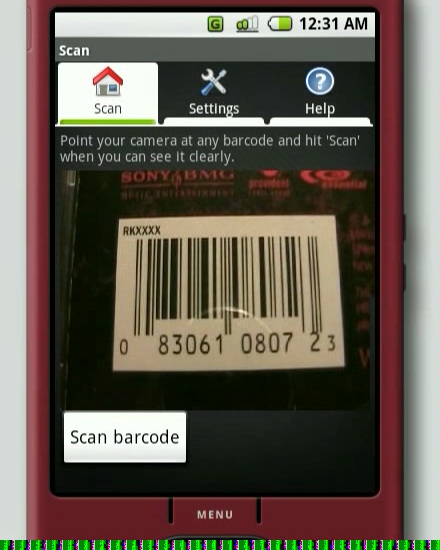
For more info on Android Scan
23half's Thrrum Uses Image Recognition For Mobile Marketing
23half Inc., a pioneer of technologies that extend the functionality of camera phones, announced the launch of Thrrum MMS Search.
Thrrum MMS Search brings together visual recognition technologies and
information search in the context of camera phones

Thrrum MMS Search enables camera phone users to find and browse information related to their physical environment using the Multimedia Messaging Service (MMS) integrated into their phones.
Users can capture a picture of any text with their camera phone and send the picture as an MMS to m@thrrum.com. Relevant search results are then sent to the users' phones.
The Thrrum MMS Search service is presently in beta and is available free of charge to AT&T wireless subscribers in the United States.
Tuesday, May 13, 2008
Corporations Fail To Budget For Upcoming Bandwidth Boom
Nicholas Carr, author of The Big Switch and of IT Doesn't Matter states the information technology (IT) departments won't matter in the next few years as computing takes place on the Net, versus on the PC.
Will corporations be prepared for the upcoming bandwidth boom?
Enterprise bandwidth requirements will more than double in the next five years, yet budgets will only increase by five per cent, according to a survey
 released today.
The research, carried out by Omniboss - a division of market analysis firm Vanson Bourne - among 100 senior IT decision makers found a further one in five executives thought their bandwidth requirements were likely to grow by 150 per cent or more.
Nearly one third (30 per cent) believed voice over internet protocol (VoIP) and converging voice, data and multimedia technologies such as video on demand would also have a significant effect on traffic in the future.
Monday, May 12, 2008
What Does The Next Google Look LIke?
Google is so big for consumers and advertisers because they are great at delivering targeted ads along side randomly desired content on the Internet. What if there was an application that could do that on the TV.

Time shifted viewing and the TiVo (DVR) are disrupting TV viewing. More eyeballs leave TV, advertisers need a dynamic service for digital video recorders (dvrs).
The NY Times asks With TiVo and the Web, what is prime time?
there has been a sharp increase in time-shifting
Some of the six million (drop in recorded viewers) are still watching, but on their own terms, thanks to TiVos and other digital video recorders, streaming video on the Internet, and cable video on demand offerings. So while overall usage of television is steady, the linear broadcasts favored by advertisers are in decline.
Dan Tynan from PC World listed "time shifted viewing + digital video recorder" as one of his top 10 Disruptive Technology Combinations.
To quote the CEO of the Next Google.
" the ability to report actual anonymous second-by-second program and advertising audience viewership data from tens of millions of set top boxes (STB)s represents a huge technological and informational leap from today's television measurement standard"
What does the Next Google look like?
The most powerful Google Analytics machine sits in your house and is the Next Google.
The Next Google will be able to collect data, second-by-second, from all services/devices connected to the broadband pipe and deliver relevant dynamic advertising to ANY display
The Next Google is able to dynamic targeted advertising while desired content is being delivered regardless of the device or time watched.
The Next Google will be able to analyze all content coming in and out of our "pipe", from ALL devices, whether it is used actively or passively and deliver targeted ads to all devices connected to this pipe.
Do you know who does all of this?
Wapple Links Print Ads To Internet Using Mobile Bar Codes
Add Wapple to the list of companies that enable physical objects to be connected to the Net using a camera phone (Physical World Connection).

Wapple customers can now generate print mobile barcodes that link to their mobile internet sites.
Each site* built with Wapple Canvas™ automatically produces its own unique datamatrix and QR codes, in fact each page on every single site will generate its own datamatrix and QR codes.
Most emerging devices come with a scanner built in. Alternatively it's no big deal for anyone to download one - to download a reader for your phone, please visit m.augme.com on your mobile handset or visit the website: http://augme.com.
Friday, May 02, 2008
The Big Switch...A Great Read
The Big Switch by Nicholas Carr does a great job of explaining how the real growth in computing is shifting from the PC to the Internet. The PC is becoming less important as the "processor".
This month's Wired magazine has a great quote from Amazon's Jeff Bezos that summarizes what Nicholas conveys.

Utility computing is Web 2.0's version of rocket fuel. "You don't generate your own electricity," Bezos says. "Why generate your own computing?" The forces driving online apps — Internet bandwidth and reliability — also mean that, in terms of data per dollar, servers in your closet or colocation facility can't compete with industrial-scale bits piped in from hundreds, even thousands, of miles away.
Intro to The Big Switch.
A hundred years ago, companies stopped generating their own power with steam engines and dynamos and plugged into the newly built electric grid. The cheap power pumped out by electric utilities didn’t just change how businesses operate. It set off a chain reaction of economic and social transformations that brought the modern world into existence.
Today, a similar revolution is under way. Hooked up to the Internet’s global computing grid, massive information-processing plants have begun pumping data and software code into our homes and businesses. This time, it’s computing that’s turning into a utility.
Thursday, May 01, 2008
Apple One Step Closer To Physical World Connection Domination
Apple one step closer to a mobile marketing powerhouse.
The big story here isn't that an airport scanner resolved a 2d bar code on an iPhone.

The big picture is that the iPhone with an iTunes browser represent the opportunity to connect the physical world with the Net using a mobile device that has an established billing platform. Powerful.
iPhone As Electronic Boarding Pass
Gerald Buckley tells how he was allowed to board an American Airlines flight from San Antonio to Dallas by having the gate agent scan the bar code of the ticket on a PDF displayed on his iPhone (this is an addition to the TSA official verifying a paper boarding pass).
A couple years ago I said that Apple could turn into a mobile marketing and mcommerce powerhouse if they introduced an iPod cell phone. (Who knew about the iPhone then).
Apple could provide the billing platform for all types of mobile content (songs, coupons, tickets etc).....and yes airplane tickets.
How could it be so powerful?
Billing method is already resolved, and the iTunes platform is so easy to use.
Think about it. Go to iTunes, download a ticket for Jimmey Buffet concert and get a 2d code, barcode on your iPod or iPhone. The billing is ALREADY IN PLACE and you just wave your iPod or iPhone at the door.
Did you ever consider what would happen if Apple introduced an iTunes browser?
When Apple introduces a mobile bar code scanning application on the iPhone, they will become a mobile marketing powerhouse.
Some other ponderings about Apple and physical world connection possibilities.
Tuesday, April 29, 2008
Lufthansa Launches Mobile Barcode Boarding Passes
From Just The Flight Lufthansa Launches Mobile Boarding Passes
German airline Lufthansa has announced a new service that allows
 passengers to use their mobile phones to access electronic boarding passes.
While the scheme is currently only available for those traveling from Hamburg to Munich or Frankfurt, it is hoped that it will be rolled out further if it proves successful.
The service sees flyers who check in online and select the option to do so being sent a boarding pass via email or SMS to their internet-enabled handsets. These passes include information such as passenger name, flight number and a 2D barcode.
SnapTell And Men's Health Magazine Create Mobile Image Recognition Campaign
SnapTell getting lots of press lately.
Soon every magazine will "turn on" their ads and offer more info simply by taking a picture and sending an MMS.
Mobile image recognition is probably the easiest way for print media to generate more interaction with a reader and get more bang of the advertising buck.

Men’s Health, the largest men’s lifestyle magazine brand in the world, has partnered with SnapTell, the leading provider of image recognition-based mobile marketing solutions, to create the first fully interactive advertising magazine in America.
Men’s Health’s July/August summer issue, hitting newsstands June 24, will feature enabled or “live” ads for readers to receive real-time promotional information from advertisers.
Using SnapTell’s Snap.Send.Get mobile marketing technology, readers will snap a photo of any advertisement in the issue with their cell phone or photo-enabled mobile device to send (or short code) to SnapTell, where an immediate promotional bounce-back will be sent to their phone.
Other ponderings on SnapTell
Selling The City Using Mobile Barcodes
Manchester Art Gallery and Marketing Manchester are looking at using QR codes to deliver information to visitors and potential clients respectively.
Manchester Art Gallery is trialling the technology, as part of its year-long Revealing Histories: Remembering Slavery gallery trail. It is displaying the codes next to six objects on the trail. Users are taken to a mobile web page with information specifically about that object.
The trial has a couple of months left to run and the gallery is still in the process of evaluating how it might use QR codes in the future. So far Wetterberg says the response has been very positive. The gallery is also looking at using QR codes to capture visitor feedback and as a wider marketing tool. Meanwhile, Marketing Manchester is in talks with online marketing company Brand Attention about running its own three-month trial, which would start in July
Thursday, April 17, 2008
MyClick Signs Mobile Image Recognition Deal With Pepsi
MyClick's patented photo recognition technology, not bar codes, opens up a world of opportunities for mobile marketing.
From Washington post MyClick Signs Mobile Image Recognition Deal With Pepsi
Two-year old Hong Kong company MyClick, an image recognition mobile marketing firm as it calls itself, that it has signed a deal with Pepsi to create an advertising campaign for it in China, aimed at 12-24 year olds.

MyClick
MyClick's technology works much like mobile barcodes, but instead of consumers snapping a picture of a 2D barcode, or QR code, they take a picture of any image?such as a logo, or a photograph?that is bordered by a MyClick frame.
MyClick's frame acts much as a 2D barcode, sending users to a specially created mobile web site for more information, or downloads. Pepsi is using MyClick in its latest promotional contest where consumers are being asked to create a profile on any of China's six major online portals for a chance to appear on Pepsi cans, which will come out during the Summer Olympics.
MyMedia is apparently doing quite well for itself in China, having already racked up an impressive number of campaigns with big international brands, including Coca Cola, Motorola, Estee Lauder, Northwest Airlines, Adidas and Pizza Hut among others.
Images are free for users to click on as well as the airtime on the web site that consumers are sent to. Advertisers pay MyMedia per click, which then splits the revenue with the carrier.
The CueCat Doesn't Seem So Dumb Now
Was connecting the physical world to the Net a dumb idea, or the CueCat device?
When barcodes can be scanned using a camera phone (Physical World Connection), billions of URLS get added to the Internet
 database, hundreds of billions of physical objects become become "physical websites".
Pay per click morphs into "pay per scan" and brands are able to interact with a consumer anywhere and anytime via mobile phone.
Kelson has an interesting story about barcodes, the CueCat and Physical World Connection called Linking The Real And Virtual.
Was the CueCat ahead of its time?
CueCat was a single-purpose device that scanned barcodes and was tied to the desktop.
There has been plenty of discussion of the CueCat being a dumb idea. The device might be considered dumb, but the idea of linking any physical object to the Internet could be a multi-billion dollar opportunity....not so dumb.
Wednesday, April 16, 2008
LTE Versus WiMax ..Mobile Showdown Ahead
Long-Term Evolution (LTE) has taken another step toward long-term stability. Seven major telecommunications companies announced Monday that they have reached an agreement on a mutual framework for licensing intellectual-property rights relating to 3GPP LTE, the next step after 3G in the evolution of mobile-phone technology.
The vendors are Alcatel-Lucent, Ericsson, NEC, NextWave Wireless, Nokia, Nokia Siemens Networks, and Sony Ericsson.
The companies have ironed out a framework they say sets up fair, reasonable, and non-discriminatory licensing for LTE technology that sets an single-digit percentage royalty (or, in the case of notebook computers, a fee under $10) on gear using LTE technology which handles all licensing issues for components of LTE technology. With a standardized royalty framework, LTE is more likely to receive backing from the mobile industry, including mobile operators and device manufacturers
Notebooks with embedded LTE will pay a combined maximum royalty in the single digits. For handsets, the single-digit royalty will be a percentage of the sales price.
LTE offers wireless broadband speeds around 100 Mbps and scales well for huge amounts of traffic. The first LTE networks are being rolled out in the US and China.
LTE is a faster and more long distance wireless system compared to 3G.
The wireless industry generally expected LTE technology to be adopted by a wide majority of the world's wireless operators, and in North America Verizon has already announced it plans to use its recent 700 MHz spectrum licenses to roll out LTE-based services in the United States.
However, the first LTE networks aren't expected to be available to consumers for a couple years, and many operators may wait even longer. In the meantime, Sprint is pushing ahead with competing WiMax technology; despite rolling back the launch of its nationwide WiMax service Xohm, WiMax technology is available now, giving it a leading edge on LTE.
My thoughts:
AT&T and VZ have grabbed a bunch of 700 MHz spectrum which threatens Sprint's WiMax.
Sprint/Clearwire won't have roaming or interoperating ability with T and VZ and they will now have the most spectrum. If Comcast and Time Warner commit to pushing WiMax it could get legs, but industry experts are becoming less encouraged with adoption.
Friday, April 11, 2008
Aviation Broadband Ready For Takeoff In The U.S.
Aircell one step closer to its goal of bringing inflight mobile broadband connectivity to airline passengers. Aircell is doing a great job of building the infrastructure for the aviation broadband industry, but will it be enough?
Aircell's internet service is expected to offer 2 Mbps speeds to customers.
Harris Corp, a large communications equipment supplier to the FAA, just announced their aviation broadband solution with speeds up to 35 Mbps per plane at this aviation conference.
Is Aircell doing the heavy lifting for Harris?
Aircell Receives Two FAA Approvals Needed for Inflight Mobile Broadband
The two approvals include a STC (supplemental type certificate), permitting installation and operation of the company's ATG (air-to-ground) network on commercially operated B-767-200s, and a PMA (parts manufacture approval) that authorizes the manufacture of aircraft parts at Aircell's Bensenville, Illinois, facility.
The important approvals follow Aircell's completion of its nationwide wireless ATG network in January and a demonstration flight across the U.S. at the end of March to show its operational readiness.
Aircell and American Airlines completed the installation of ATG technology on a commercial aircraft in January, and American is now completing the equipment installations on its remaining 14 B-767s which are expected to go live sometime this summer.
This high-speed broadband Internet service is made possible by AirCell's unique air-to-ground network, which uses the latest technology to transmit and receive data between the ground and the aircraft. Speeds will be similar to what you experience in your home or office with DSL.
More on aviation broadband.
Wednesday, April 09, 2008
Pondering Primate And Team Monkee Do Off To IronMan Arizona
It's IronMan triathlon racing season time again.
Representing Team Monkee Do, I am headed out to Tempe for year's IronMan Arizona race on Sunday April 13, 2008.
Follow the action live at www.ironmanlive.com.
Bib number 1174
I-Nigma Uses Mobile Bar Codes To Help Retailers
We are starting to see major publications discuss Physical World Connection (mobile phones and bar codes) on a daily basis. This is a good sign for this space.

From Washington Post Expand Your Empire
The coolest ad technologies aren't the ones that cost the most--they're the ones that engage users. (It's all about offering some type of content in return for permission to advertise on the phone)
Bar Codes With Extra InfoWhile you may think of "airline check-in" or "mail tracking" when you see the black-and-white squiggles that make up QR, or "Quick Response" codes, these 2-D data matrices are beginning to find their place in advertising.
One QR campaign developed for the clothing industry by Philip Warbasse, founder of Los Angeles-based Warbasse Design, puts the codes on in-store apparel that allows shoppers to purchase sizes not in stock--right on their phones. The codes also offer customers a same-day in-store coupon, and other codes in the campaign help upsell the customer with a discount on a second item in the store if they buy it the same day.
Since QR codes cost essentially nothing to produce, go create your own and download a reader for your phone while you're at it from i-nigma. You can create simple promotions like coupons inexpensively and quickly. One caveat is making sure your promotion will appear on customers' phones as you intend it to, which means hiring someone with mobile design experience if you're offering anything other than a plain-text promotion
Tuesday, April 08, 2008
MobileDiscovery GetsFailing Grade For Case Western's Mobile Bar Code Trial
In parts of Asia and Europe, marketers have been using bar code technology to help sell things to people on their cellphones. There have been a few small-scale tests, but judging from the experience of one under way at Case Western Reserve University in Cleveland, the technique is nowhere near ready for widespread use.
Considering this was the first major trial for Physical World Connection, the marketing guys at MobileDiscovery dropped the ball big time. (Jonathan Bulkeley, CEO of ScanBuy, informed me that they had nothing to do with the marketing of this campaign)
In my opinion, advertisers are failing to grasp how big Physical World Connection (bar codes and mobile phones) is and how to implement it. Mobile bar codes can link a brand directly with a consumer immediately.
This Case Western campaign is lacking any creativity and focuses on the benefits for advertisers and carriers, not the consumers. A big mistake.

From the N.Y. Times Bar Code Sales Tool Failing
A company called Mobile Discovery, based in Reston, Va., is conducting the test at Case in conjunction with the university’s engineering school, whose students are helping to manage it. Students and other people affiliated with the university can download software to their cellphones and then can get campus bus arrival times, order magazine subscriptions, enter a sweepstakes sponsored by QVC and get text alerts from USA Today, among other applications. (they couldn't find a more hip publication than USA Today to participate? how many college kids read USA Today?)
They are also called free sweepstakes for a reason.
Interest in the pilot project, which started Feb. 1 and will run at least through May 15, has been tepid, according to students on campus, in part because of the cellphone fees associated with it. (It costs 2 cents or more to check when the next shuttle bus arrives, for instance.)
It's ridiculous to make consumers pay for this type of advertising.
Five phone carriers, including Sprint and AT&T, were cooperating in the trial — but not contributing money for it.
If you want to see mass adoption of this technology, carriers need to turn off the meter for a bit and see who and how consumers scan mobile bar codes. Think of this as an R/D expense for the next generation advertising model. The revenues will come but first you need to let early adopters (the targeted demographic) decide HOW and WHAT they want to use it for.
According to Ms. Dietz of the campus paper, the biggest downside of the Mobile Discovery trial is that the technology is not free.
QVC, the shopping network, introduced a campaign last month called Make It or Break It, inviting participants in the trial to create codes on mobilediscovery.com, then post them around campus for others to scan. Each scan gives the student an entry into a QVC sweepstakes, increasing the chance of winning a prize.
Jeffrey Charney, a QVC marketing director said, “Bar codes are the next killer app,”.
I think that is true, but in this case QVC is relying on the consumer to create the codes. A very bad idea. That will only work AFTER it gets traction.
So far, the most popular use of the technology at Case has been real-time arrival information for campus buses, called Greenies.
This is actually beneficial to the consumer. They get timely information when scanning a code. If you want to combine ads with the bus schedule that would work.
To get rapid adoption of the scanning application on the phone, you need to find a captive audience and include a contest. Did anyone think of a Case Western sporting event? In an arena, or stadium your have hundreds or thousands of people looking at the scoreboard during the game. A simple "send a text to XXXXX to get your EZCode" would work. Include a couple EZCodes in the program for people to scan to win a free Coke etc.
Did the marketing guys talk to any of the local retailers? Are there any campaigns that require a consumer to scan the same code to promote ease of use? Are there any time sensitive campaigns? Any viral ideas?
“Students don’t perceive it as practical,” Ms. Vermeersch said. “Why would anyone actually pay for advertising?”.
They won't. The key point is to give the consumer something in return for permission to advertise on the phone.
The software being used in the Case pilot project, EZcode, was developed by Scanbuy, a mobile marketing company that is conducting a separate trial involving restaurants and other stores in its home city, San Francisco.
Did the marketing guys think of placing a notice in the daily school paper on how to download the EZCode software application?
Outside of a couple sweepstakes, what other goods/info were offered?
This was the first major trial of Physical World Connection in the US. The lack of creativity is very disappointing.
Next generation technology should have next generation marketing vision directing it.
Friday, April 04, 2008
AT&T Uses Mobot's Image Recognition For Mobile Marketing
Until all camera phones can scan 1d bar codes, or there is a standard 2d bar code, images will do just fine.
Instead of using bar codes, AT&T (and others) decide to make it easy for consumers and just use images. Take a picture of an ad, book cover, DVD and send via MMS for more information.
AT&T has quietly agreed to support a marketing service that lets advertisers design mobile phone campaigns that link two-dimensional print ads, billboards and product packaging with interactive digital media.
Other U.S. carriers--Verizon and T-Mobile--are expected to follow suit, according to sources close to the project.
The service relies on an ordinary cell phone with photo capability and sophisticated image recognition software designed by Mobot, a mobile visual search company in Lexington, Mass. Consumers take a picture of any traditional two-dimensional ad, product package, or logo and send it by multimedia message (MMS) or a picture message to Mobot.
Scientists at MIT and the University of British Columbia, among others, developed the image-recognition technology that Mobot founder and CEO Russell Gocht licensed to develop the advertising platform.
Here's how the image recognition space stands. Google acquired Neven Vision and Microsoft has their own application called Lincoln.
I'm glad to see that AT&T (and others) are choosing to go with a smaller player like Mobot, rather than team up with the bigger image recognition players. But I wonder, could that be due to intellectual property issues?
Pondering Primate readers should be very familiar with Mobot.
Over a year ago Mobot was acquired by a mobile marketing company for approximately $10m. My company, Visionary Innovations, was instrumental in what was called, "The Marketing Wedding of the Year".
In December 2006, the acquiring company sold Mobot back to its founders.
Here's why Mobot was sold back.
History of Mobot on the Pondering Primate.
Instead of using bar codes, AT&T (and others) decide to make it easy for consumers and just use images. Take a picture of an ad, book cover, DVD and send via MMS for more information.
AT&T has quietly agreed to support a marketing service that lets advertisers design mobile phone campaigns that link two-dimensional print ads, billboards and product packaging with interactive digital media.

Other U.S. carriers--Verizon and T-Mobile--are expected to follow suit, according to sources close to the project.
The service relies on an ordinary cell phone with photo capability and sophisticated image recognition software designed by Mobot, a mobile visual search company in Lexington, Mass. Consumers take a picture of any traditional two-dimensional ad, product package, or logo and send it by multimedia message (MMS) or a picture message to Mobot.
Scientists at MIT and the University of British Columbia, among others, developed the image-recognition technology that Mobot founder and CEO Russell Gocht licensed to develop the advertising platform.
Here's how the image recognition space stands. Google acquired Neven Vision and Microsoft has their own application called Lincoln.
I'm glad to see that AT&T (and others) are choosing to go with a smaller player like Mobot, rather than team up with the bigger image recognition players. But I wonder, could that be due to intellectual property issues?
Pondering Primate readers should be very familiar with Mobot.
Over a year ago Mobot was acquired by a mobile marketing company for approximately $10m. My company, Visionary Innovations, was instrumental in what was called, "The Marketing Wedding of the Year".
In December 2006, the acquiring company sold Mobot back to its founders.
Here's why Mobot was sold back.
History of Mobot on the Pondering Primate.
Thursday, April 03, 2008
Amazon's TextBuyIt Disrupts Physical World Retailing
I'm surprised it took this long to introduce this. Physical retailers will have to get used to price comparisons AND purchases made from online competitors in their store.
What can physical retailers do in order to provide value?
Until camera phones can scan a barcode, or resolve an image on a book cover, Amazon's TextBuyIt mobile application will disrupt physical book store retailers.
From Fox News Amazon Launches TextBuyIt
In less than a minute and using only text messages, Amazon.com customers can find the product they are looking for and complete a purchase using TextBuyIt.
Simply send a text message to "AMAZON" (262966) with the name of the product, search term or a UPC or ISBN code, and, within seconds, Amazon replies with the product or products that match the search, along with prices.
To buy an item, customers simply reply to the text message by entering the unique single digit number next to the item they want. Customers will then receive a short phone call from Amazon with the final details of their order and asking them to confirm or cancel the purchase.

When customers choose to purchase something for the first time using TextBuyIt, they will be asked for their e-mail address and shipping ZIP code they use for their Amazon.com account. With this information, Amazon uses customers' default settings for payment method, shipping address and shipping speed, including 2-Day shipping for Amazon Prime members.
Microsoft Fails Again With White Space Tech Device
A device submitted by Microsoft for US Federal Communications Commission (FCC) testing of wireless 'white spaces' technology has stopped working and been taken out of the process.
The wireless prototype, which was not made by Microsoft, unexpectedly stopped working on Wednesday, Microsoft said on Friday. In February, the FCC took another Microsoft-submitted device out of testing because it had power problems.
Microsoft said the problems that took the two devices out of testing were unrelated to interference and that the units were experimental, not production devices.
Mobile Discovery Links The Physical World With Mobile Bar Codes
Add privately held Mobile Discovery and their CodeIntelligence to the list of companies that link a mobile phone and a physical object to the Internet.
The company was founded to help advertisers breathe new life into print media and to help wireless carriers develop new revenue streams stemming wireless data services. This is accomplished by offering traditional print advertisers a disruptive and convergence-enabling service, which delivers a new and revolutionary customer experience.
Case studies include Billboard Magazine, Wired Magazine and Sprint Website.
When Sprint decided to use codes online they chose Mobile Discovery’s Code Management Platform (CMP). Called CodeIntelligence™

By combining mobile 2D code technology with advanced intelligence Mobile Discovery delivers benefits via sophisticated backend infrastructure hidden behind a simple and intuitive GUI that puts control in the hands of art directors, brand managers and product manages.
Using the Mobile Discovery CodeIntelligence™ platform, advertisers can create, deploy, manage and measure a print ad campaign injected with new media capabilities. This new solution extends the value of print ads by making them interactive, multi-media and e-commerce enabled.
Wednesday, April 02, 2008
Intel Sees Promise For Mobile Barcodes And Physical World Connection
From ZDNet Intel Reveals Its Vision For Mobile Phone Evolution
Intel has set its technicians working on a new initiative that it hopes will get mobile devices piggybacking on other devices its user may come across, as well as making use of the increasing number of sensors--such as cameras and GPS--within the device itself.
The terribly-named Carry Small Live Large plan is one of the company's "four or five big bets" for upcoming technology trends, with engineers working on new methods to use the applications available on mobile phones in ways that aren't dependent on the form factor of the device itself.
The Carry Small Live Large scheme is also looking at ways to utilize the data generated by the range of sensors included within mobile devices. According to Kahn, one of the oldest mobile sensors--the camera--has some of the greatest potential.
"That sensor could take a look at a barcode and give you information on the product, it could be connected to a database that you're looking at as a tourist", Kahn said. For example, by allowing the user to take a picture of a building in a foreign city, and using location information from the phone's GPS combined with the image taken by the camera-phone to find the building on a database and then deliver data on it back to the user's phone.
Tuesday, April 01, 2008
NextCode Works With Kanematsu And Kraft Foods For Physical World Connection

From Media Post Mobile Users Searching For Local Consumption
Moira Jacobs, director of business development for the mobile solutions group at Kanematsu USA, a mobile solutions provider, came to the conference to learn more about mobile commerce and integrating two-dimensional bar code technology on product packaging, print and television advertising. The codes let consumers download information to their mobile phones.

Kanematsu is working with Kraft Foods in the United States to develop a way to put 2-D bar codes from Boston-based NextCode on product packaging, connecting consumers to nutritional information, recipes, coupons, and more on the company's Web site.
The technology relies on a standard camera in mobile phones, but does require consumers to download a small application. "You either need to download a Brew application on your phone, similar to the one we developed, a Java application, or in the future phones could come pre-loaded with the application on the handset," Jacobs says.
Subscribe to:
Posts (Atom)