Tuesday, April 24, 2007

Intellareturn Is A Physical World Connection Player


Intellareturn's Append solution bridges physical mail with mobile phones. Another billion set of objects will soon get their own "barcode" and will be able to be connected to the Internet via mobile phone.

Add Intellareturn and their Append (physical world hyperlink) to the list of companies that offer Physical World Connection.


The Append service , integrates NFC and related RFID technology applications to the mail. Through its innovative Append® application, postal mailers can now interact with sent mail to view and exchange supplemental rich media and content related to a letter, envelope, postcard or package—just by waving a Near-Field Communication (NFC)-enabled mobile phone over the Intellareturn Smart Stamp®.

Intellareturn's Append® microchip-based "Smart Stamp" system links supplemental text, audio and video files to envelopes. Elliot Klein of Intellareturn Corp. declared this will one day "transform how we utilize envelopes and the postal mail." The Smart Stamp service can be sold as a book of self-adhesive labels or pre-manufactured into envelopes, taking envelope manufacturers into the wireless ecosystem with new business models to store, control and deliver rich-media content.
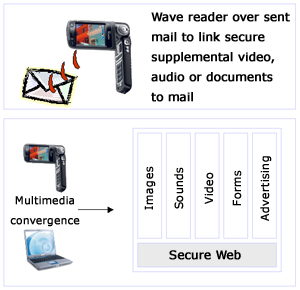
Business and consumer mailers will soon tap the mobile Internet's power to privately access supplemental documents, video and audio recordings—simply by waving their mobile phone or PC equipped with built-in or add-on NFC reader with a postage-sized "Electronic Stamp" on the addressable side of mailings.

Append opens the digital envelope, moving beyond static and familiar paper mail communications to integrate a rich media experience with postal mailings. Through the Intellareturn process and solution, Append securely links Internet content to bring new interactivity and digital relevance to the postal mail system—one of the biggest traditional paper communications mediums in the world.

These electronic stamps cost less than the price of a traditional first-class stamp. Intellareturn is now creating the ecosystem and standards to make this new technology and postal capability available

Through the Intellareturn process and solution, Append securely links Internet content to bring new interactivity and digital relevance to the postal mail system—one of the biggest traditional paper communications mediums in the world.

Intellareturn Corp., a New York City-based mobile services company founded by Elliot Klein, Benoit Richard and Ian S. Gertler, transforms traditional postal mail with NFC and related wireless technologies and bridges it with the mobile Web ecosystem

Carnival Of The Mobilists #70


This week Michael Mace at Mobile Mobility hosts the 70th edition of the Carnival of the Mobilists.

It's always interesting to see what some of the top mobile bloggers are pondering.

Sunday, April 22, 2007

XXScan Offers Complete Physical World Connection Mobile Marketing And Commerce Solution

XXtreme Measures with their XXScan platform , is no stranger to the Pondering Primate.


This time last year I said they offered the most complete physical world connection mobile marketing package.


Xxtreme Measures, LLC is a technology based marketing company with offices in the U.S., Japan, Brazil, UK, and China. XXtreme's Xxtreme Pay, Inc Merchant Services and Mobile Payment Technology that specializes in m-commerce, e-commerce, T-commerce and have build a unique off-deck and On-deck physical world connection solution.

Today they are unveiling XxScan that uses XXCodes to link the physical world to the Internet. XxScan offers an end to end solution from Code+Application+Payment Gateway+Merchant Services..... a one stop shop.


They provided physical world connection marketing campaigns with Time Warner, a major movie launch .


XxScanTM provides easy access to the content when related to a unique Interactive XxCodeTM barcodes.


Simply point your camera phone at the Xx-CodesTM or enter a 7 digit premium code in software and you are instantly directed to the associated content -music,
videos, media, graphics, text’s, pictures, applications and more.


XxScan TM eliminates the need for manual multi-key-tap-entry and lets you get to content faster!

Xxscan is focusing on spreading Xxscan's XxCodes virally on multi platforms, like MySpace .

To download the XXScan application or point your mobile browser to www.xxscan.com or xxscan.net .

supported phones


US and Interntaional Carriers

Friday, April 20, 2007

Nokia Mobile Codes In Beta....What's Next?

Physical World Connection gets a big boost.

Nokia starts offering the ability to create and read Mobile Codes. Microsoft offers the ability to create your own 2d codes too. Recently the largest consumer good packaging company in the world announced they would be placing them on packaging.

I think the chicken and egg are pretty much covered here. To complete the loop, a social network site should starting offering the ability to create and scan 2d codes too. Let the targeted demographic determine the creative applications for these codes.

The quicker consumers and corporations can create their own 2d codes (physical world hyperlinks) through a universal platform, the quicker PWC gets adopted.

On Nokia's Beta Site , they are offering the ability to create a 2d code (Mobile Code), and several software applications (downloadable), that allow you to scan the Mobile Codes with a Nokia camera phone. If you have a Nokia N93, N93i, N95 or E90, you will find the Nokia barcode reader preinstalled on your device, ready to scan mobile codes around you.


If the carriers that work with the compatible Nokia phones were smart, they would start offering the ability to create Mobile Codes (physical world hyperlinks) on their site.

If I am Nokia, I would be looking for sites that allow individuals to continuously generate content. Know which ones I would target first?

Can you see how Google could incorporate 2d code creating ability into their advertising mix?

What are 2D codes?
'Mobile codes' are in fact 2D codes, two-dimensional codes that can hold much more data than ordinary barcodes - linear 1D codes - due to their matrix structure.


The Mobile Code for The Pondering Primate.


In what format are the mobile codes I have created?
We like open standards: the two currently available open-standard formats for 2D codes are Datamatrix (DM) and Quick Response (QR). Our site uses currently the Datamatrix standard. Some of the readers proposed on this site can read QR codes as well, including the Nokia barcode reader

Learn more about Nokia's Mobile Code project

Thursday, April 19, 2007

Microsoft Colorful Barcode Followup And How It Affects Google

Google may be kicking Microsoft's butt in the PC search space, but Mister Softee has unveiled and acquired some interesting applications that could make them a formidable player in the mobile space.

Microsoft, using a mobile phone, is actually starting to link objects in the physical world, to the Internet.

Yesterday Microsoft's colorful 2d barcode (HCCB) announcement will have a profound impact on Physical World Connection (PWC). The multicolor 2d barcode technology was developed by Microsoft Research to assist in the identification of commercial audiovisual works such as motion pictures, video games, broadcasts, digital video recordings and other media.

In the last few months Microsoft has introduced a:
speech recogntion browser
1d barcode scanner
2d barcode scanner
mobile image recognition engine and an
RFID browser

Is Microsoft developing the operating system for the "Internet of Things"?

Having a day to ponder, I see enormous opportunities for Microsoft in the mobile marketing space and makes my prediction even more likely.

After the DoubleClick-Google deal, it is more important than ever that Microsoft try to "own" the mobile marketing space.

Google, while they are dabbling in print and radio, is still pretty much a digital world player. How will Google connect the physical world to the Net? How will they continue to dominate the Internet advertising space if they are only using SMS for mobile marketing?

See why Google should be, or maybe is, looking at these guys and will offer a 2d code creating site/application. This acquisition would allow Google to offer clients the ability to connect almost ANY physical object to the Internet using existing 1d codes or newly created 2d codes. It would also add billions of objects in their database.

What happens if Microsoft buys them first?

A big transformation will come when physical objects/content are/is linked to the Internet and Microsoft is already in the lead there. I don't see that same size change or demand occurring in trying to make digital content physical.

Once the group starts issuing the barcodes, studios and producers will be able to link their Web sites to that database.

Did Microsoft indirectly just land the entire entertainment industry as a mobile marketing client? What is the next big component, that the entertainment industry uses directly for promotions, that Microsoft should go after? Who is producing the next generation barcode for Physical World Connection?

Thoughts, comments?

Mobile Marketing Association Discusses 2D Code Adoption


Laura Marriott, the Executive Director of the Mobile Marketing Association, has a nice story at ClickZ on the progress of 2d codes and Physical World Connection (PWC).

Laura talks about how 2d codes are being used in a couple recent mobile marketing campaigns. She also interviews the CEO of Scanbuy for his thoughts on PWC.

Also known as QR codes, these allow consumers to use their wireless devices to interact in a graphical manner with traditional and digital media. The unique, two-dimensional bar codes, which can be placed on any item, allow the consumer to take a picture using their MMS (camera phone functionality) on a mobile device. Then, through bar code reading software, the 2D code is interpreted to provide product information, downloads, and more. 2D codes are a visual system allowing consumers to access relevant information much like short codes, IVR or other mobile media techniques.

The Paris transport system launched an interactive campaign using 2D codes with New York-based Scanbuy. The consumer can scan a code and see when the next bus or subway will arrive. There are over 160 bar codes in a single station!

I asked Jonathan Bulkeley, CEO of Scanbuy , when we might see 2D applications come to the U.S. Obstacles to adoption here include lack of camera phone (MMS) consumer adoption, as well as cost-effective pricing models.

Demand on the advertiser side is huge. Advertisers get it , says Bulkeley. Print publishers are especially interested in 2D campaigns and what the visual opportunity can do for them.

Cosmo Girl launched an application with Mobot last year based on pure image recognition. Cosmo Girl readers were encouraged to take photos with their mobile device of ads or features in the publication and send them to the magazine for a chance to win prizes. The Cosmo Girl application wasn't based on 2D codes, but rather image recognition. Bulkeley says image recognition is the “holy grail, but making it a reality is years away for a number of reasons."

Pondering Primate readers might find Jonathan Bulkeley's "brick and mortar to Internet" transition background a bit interesting. He is no stranger to transformation and prior art patent disputes. During his term as CEO of BarnesandNoble.com, Amazon.com filed a lawsuit against BN.com, claiming BN.com was infringing on their "one click to buy" patent. The updating of US patent law to account for the Internet age started to pick up steam at this time.

The outcome? Let's just say innovation trumped prior art.

Yogi Berra might say "This is like deja vu all over again".

Wednesday, April 18, 2007

Microsoft Adds Color And FeaturesTo Barcode Scanning

Things are really starting to heat up in the Physical World Connection space. I see lots of interesting physical world connection applications here. Microsoft creates their own unique 2 dimensional code (2d code) and signs a licensing deal with the major bar code numbering agency.

Will Microsoft and the ISAN create a "registry" for physical world objects that can be connected to the Internet?

Microsoft has a 2d code scanning application for a camera phone, and a 1d code scanning application.

Because DuPont and Microsoft are launching Physical World Connection platforms, this seems even more unnecessary now.

Microsoft's HCCB code offers authentication as well as a connection to the Internet.

From IT Jungle Microsoft breaks the color barrier for barcode


The IT industry has seen various improvements in labeling technology, starting with simple two-dimensional barcodes, more advanced three-dimensional barcodes, and, finally, radio frequency identification (RFID), the "barcode killer." Now, Microsoft is trying to infuse new life into the tired black-and-white barcoding scheme with a new colorized barcode format.

The High Capacity Color Barcodes are expected to start showing up on DVD discs later this year.

According to Gavin Jancke, director of engineering for Microsoft Research and the inventor of the new high capacity color barcode (HCCB) format, color barcodes hold more information and look better than traditional black-and-white barcodes.

Microsoft declined to disclose financial terms of the agreement with the ISAN International Agency. The PC and mobile-phone software needed to read the high-capacity bar codes will be available for free.

What will this do to the PWC space?

On Monday, Microsoft announced that the International Standard Audiovisual Number International Agency ((ISAN-IA), the Swiss agency charged with administering the ISAN numbering system, has licensed HCCB technology and plans to incorporate it into an authentication system for weeding out legitimate motion pictures, video games, broadcasts, and digital video recordings from forgeries.

In addition to authentication, HCCB has other uses. As the technology improves, Microsoft envisions barcodes being displayed on TV or computer screens, on movie posters or DVD or CD cases, or on magazine ads or billboards. To get more info, consumers would scan these color barcodes with their camera-equipped cell phones or Web cams.

New security features can also be incorporated into the color barcode. Microsoft cites a company called DatatraceDNA that plans to use HCCB to build anti-counterfeiting security protection features that could be added during the manufacturing process of most products. The company refers to this process as Digital Nanoparticle Authentication, or DNA.

Jancke has a European patent on the High Capacity Color Barcode, and a U.S. patent is pending.

Wednesday, April 11, 2007

China Uses 2D Barcodes For Mobile Ads

This article does a good job of summarizing the Chinese Physical World Connection players.

From Business Week China:Cracking the Mobile Ad Biz

The lucrative potential of the mainland's tech-starved mobile advertising market could be unlocked by two-dimensional barcodes (2d codes).

A new kind of mobile advertising technology, however, could be the key that unlocks the country's 461 million mobile phone screens to advertisers.

The technology uses two-dimensional barcodes, a more evolved cousin of the humble Universal Product Code found on groceries, to create an advertising channel with an aura of science-fiction.

Two-dimensional barcodes can be used to bridge the online and offline worlds, turning, say, a coffee table into a physical hyperlink, and your mobile phone into a giant mouse pointer. You "click" the barcode on the coffee table by taking a picture of it with the camera on your phone, and then are automatically taken online.

For a three-month period that ended in February, Chinese barcode pioneer Gmedia provided Starbucks with barcodes to display on tabletops in the chain's 50 outlets in Beijing. When a user clicked on one, they were linked to a website that allowed them to redeem a free coffee.

Another company trying to cash in on physical hyperlinking is Hong Kong-based MyClick . Although it uses a patented photo recognition technology, not barcodes, the end result is virtually identical. Any visual medium - a magazine page, billboard or television commercial - can carry an image framed by a special border. The user simply snaps a photo of the framed image.

"Advertisers will know where someone was when they clicked the ad and guess what they were doing at that moment," said Sage Brennan of research firm JLM Pacific Epoch. "If [barcode-reading software] is in every handset around the country, the incentive to insert a tiny code [in advertisements] is huge."

Gmedia and Inspiry , which promotes its own standard, have announced partnerships with China Mobile. Inspiry has also persuaded handset manufacturers to pre-install its software in "hundreds of thousands" of units, according to Lawrence Tse, a general partner at venture capitalist firm Gobi Partners , which has invested in the company

Pondering Primate Off To IronMan Arizona

I am heading out to Tempe for IronMan Arizona.


The IronMan racing season starts this weekend in Tempe.

An IronMan race tests the body as well as the mind. After 8 hours of doing anything physical the mind takes over.

The race is on Sunday April 15, and you can watch the results live at IronMan Live

My bib number is 1175.

Look closely and you might see MonkeeDo

Air Force Uses Mobile Barcodes For Recruitment

I like seeing a major advertising agency like Omnicom Group starting to incorporate physical world hyperlinks in their campaigns.

It looks like this campaign is using EZ Codes .

From AdAge Air Force turns to mobile marketing to up recruitment


On April 13, fans wandering around the sidelines of the Texas Motor Speedway in Dallas will be the first to experience the mobile arm of GSD&M's "Do Something Amazing" campaign for the United States Air Force.

The Air Force said it has hit all its recruitment goals since hiring the Omnicom Group agency, and with 81% of the Air Force's target audience toting cellphones, mobile was an obvious next step.

The tease? As part of the Air Force's "Do Something Amazing" tour, which makes stops at motocross, Nascar and other sporting events around the country, Bluetooth transmitters will be set up in areas around the tracks and stadiums. The transmitters ping any mobile device set to accept messages sent via Bluetooth, sending consumers invitations to stop by the tour and "check out what it's like to do something amazing."

Once inside the event space, consumers will find pods dedicated to each of the career paths the Air Force has to offer. Within those pods will be stickers sporting QR quick-response codes that will enable users to download documentary-style videos to their phones about Air Force careers.

Tuesday, April 10, 2007

Telefonica Espana Adopts Scanbuy's Mobile Barcode Platform

The largest wireless operator in Spain adopts Scanbuy's physical world connection platform.

From CBS Marketwatch Scanbuy and Telefonica Espana launch mobile barcode solution

Scanbuy, Inc., a global provider of wireless commerce solutions, today announced the completion of its mobile barcode platform created for Telefonica Moviles Espana , the largest wireless operator in Spain (TME).

The platform is the first of its kind in Europe to combine multiple uses of barcodes on mobile handsets
.

Scanbuy's platform supports TME's strategy to facilitate access to mobile content and use of the handset as a transaction device for its 21.5 million subscribers and will be the first integrated platform combining couponing/ticketing and print-to-mobile. Atos Origin , an international information technology services provider, has been selected to provide systems integration and project management services to bring the solution to market.

By selecting Scanbuy's mobile barcode technology, TME will offer its Movistar subscribers access to content by simply pointing their camera phone at a two-dimensional barcode, to be found in advertising, on TV, business cards or websites. Scanbuy's client application ensures quick and easy access to online data and multimedia services from a wide range of handsets. Scanbuy's service platform will allow content providers to create, manage, and monitor their barcodes and to launch couponing and ticketing campaigns by sending barcodes within SMS or MMS.

"Being selected by Telefonica Moviles Espana, the leading mobile operator in Spain, is not only proof of Scanbuy's best of breed mobile barcode technology but it also positions Scanbuy as the global industry leader," said Jonathan Bulkeley, Chief Executive Officer of Scanbuy, Inc.

Jameson Whiskey Uses ShotCodes For Mobile Campaign

Jameson Whiskey has launched a unique campaign in Spain using branded ShotCodes.


ShotCodes are circular barcodes especially developed for camera mobile phones. Campaign participants can use these ShotCodes as offline hyperlinks by installing the ShotCode software on their mobile phones. They aim their phone’s camera at a Jameson ShotCode, click, and they’re automatically connected to the Jameson Whiskey campaign site where they participate in a prize draw for an all expense paid trip to Hollywood.

The Jameson Whiskey ShotCode is the first branded ShotCode to be released, it contains the Jameson wap-site address: wap.jameson.com as well as ShotCode.com and has the Jameson logo in its center. The campaign is set to run for a year and will be covered on free postal cards and outdoor advertising.

“ShotCode’s success has always been related to its unique shape. Now that we’ve finally launched our branded versions we’re certain that integration of ShotCodes into visual campaigns will be even simpler” says Dennis Hettema, founder & creative director of OP3 , the company behind ShotCode.

Jameson’s Spanish management wholeheartedly agrees as they chose ShotCode from amongst the wide selection of available mobile barcode scanning technologies because of its distinctly recognizable shape, ease of use and unlimited amount of application areas.

ShotCode’s road to success continues as they now sport over 6,000 clients worldwide including companies such as The Coca Cola Company, Nokia, Heineken and Xbox. Together they’ve created over 400,000 ShotCodes that have been placed on over 50 million products.

In a market with a high amount of competition, OP3 consistently launches the biggest campaigns making the company the fore-runner of the mobile barcode scanning market outside of Japan and Korea.

ShotCode is the flagship product of OP3, a Swedish / Dutch organization in the proximity marketing space. Launched in 2003 and with customers such as Heineken, Coca Cola, Xbox and Holland Innovation

Campaign by Publiquest

Monday, April 09, 2007

Out With The Old, In With The New

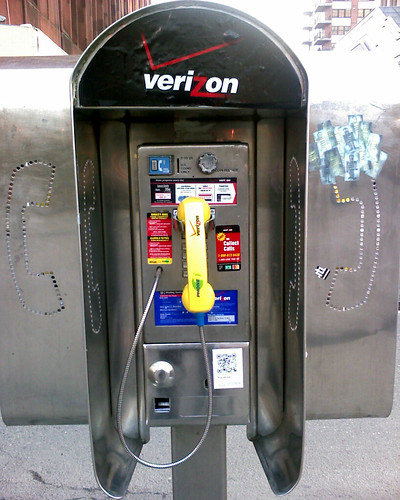
I thought of cute lines that include Verizon, "remember when?" and a couple others.

Sometimes a picture does a better job of telling a story.


Look closely below the handset.

Saturday, April 07, 2007

Google Offers Local Voice Search.. 1-800-GOOG-411

The speech recognition search engine battle is starting to heat up.

A couple weeks ago Microsoft acquired speech recognition player TellMe. Now Google offers a speech recognition local search application for the phone.

With this application, Google is blending the PC with the mobile phone, and will be creating another revenue stream for keywords.

Can you see the opportunity for "mobile search" and "mobile find" with this application?


Google Voice Local Search is Google’s experimental service to make local-business search accessible over the phone.

To try this service, just dial 1-800-GOOG-411 (1-800-466-4411) from any phone.

Using this service, you can:

* search for a local business by name or category.
You can say "Giovanni's Pizzeria" or just "pizza".

* get connected to the business, free of charge.

* get the details by SMS if you’re using a mobile phone.
Just say "text message".

And it's free. Google doesn’t charge you a thing for the call or for connecting you to the business. Regular phone charges may apply, based on your telephone service provider

Wednesday, April 04, 2007

Physical World Connection Summary At CTIA 2007

The CTIA show is always informative in many ways. There are press releases for new products, new(games, search engines, email apps) and numerous companies exhibiting the "next thing" in mobile. My focus is on mobile phones connecting the physical world to the Internet through physical world hyperlinks (PWH).

I have often found the key developments are discovered off the main showroom floor though.

The easiest way to find out what is really happening in this space (and I encourage going to CTIA for this reason) is to talk to the companies that will or can adopt this technology. It is becoming clear which Physical World Connection (PWC) companies are getting their platforms adopted, and who is still trying to get traction.
Pondering Primate
I saw all of the PWC companies on my PWC list that were there at the show, and discovered a couple new ones that I will be adding shortly.

Last week I saw a 1d code (barcode) scanning solution for camera phones that doesn't require any special lens attachment and works on major handsets. In addition, this application can read 2d codes as well. This solution could play a key role in the Physical World Connection space.

More on this company later.

In my opinion, the 2nd quarter of 2007 will be the tipping point for Physical World Connection adoption in Europe. One major wireless carrier has already embedded a PWC platform. Two additional major carriers should be announcing a PWC platform adoption shortly as well.

I had the chance to see some pretty exciting upcoming 2d code mobile marketing campaigns. These campaigns include scanning codes on various objects for videos, coupons, and a host of other permission based marketing. The brands using physical world hyperlinks (PWH) is impressive.

One of the biggest reality shows will be incorporating PWH into their upcoming season. This campaign and the PWH become part of the show and could be a terrific way to educate consumers on PWC. I can see how a brand could piggyback just one show and one PHW into a major campaign.

A major recording star is incorporating PWH into a campaign for their next album.

One PWC is finding a way to utilize a captive audience and incorporate their platform. Many will say "why didn't we think of that?".

Microsoft throwing their hat in the PWC ring is shaking up things a bit too. There were some interesting comments from the carriers and PWC cos about this.

2006 was a year some of the PWC players would like to forget too. Players in the space will know what event I am referring to.

Probably the two biggest developments I came away with at CTIA are:

1. a company with a 1d code (and 2d code) scanning application that is still in stealth mode
2. the impact DuPont and their 2d code announcement is having on the Physical World Connection space.

These two developments could allow all existing consumer goods and newly created consumer goods (packaging) to be connected to the Internet.

The figures for Internet advertising only continue to grow, and companies that measure clicks/ traffic on ads are being courted. I wonder what value will be place on a permission based marketing solution that can deliver ads/content directly to a mobile phone when the consumer is holding their product in hand?

There are lots of Physical World Connection opportunities for companies or individuals with vision

Tuesday, April 03, 2007

Nextcode Uses Physical World Hyperlinks For Boston's Freedom Trail

Nextcode is using physical world hyperlinks for tourism.


For those of you who are planning to visit the Boston Freedom Trail in the next few months, you're in for a special treat: A group of young talented people will help you learn more about the points along the trail by watching a video, listening to audio or other pieces of content that will be available on the web, to your own mobile phone. You will be able to learn more and thus enjoy your visit much more.

The project is called "Freedom Trail Reloaded" or otherwise has also earned the name DiMO (Digital+Mobilities Project)

A more detailed explanation .

Sunday, April 01, 2007

Camera Phones Connect Bar Codes To The Net

NY Times has a story on Physical World Connection titled Bar codes talk to your cell phone .

They discuss a few of the applications, and companies, that are using 2d codes as physical world hyperlinks. However, this story fails to address some recent events that are helping to determine which companies are gaining traction quicker than others.

The most promising way to link cellphones with physical objects is a new generation of bar codes: square-shaped mosaics of black and white boxes that can hold much more information than traditional bar codes. The cameras on cellphones scan the codes, and then the codes are translated into videos, music or text on the phone screens.

In Japan, the codes did not become mainstream until the largest cellphone companies started loading the code readers on all new phones a few years ago. Now, millions of people have the capability built into their phones, and businesses, in turn, are using them all over — on billboards, street signs, published materials and even food packaging
.

A couple significant events took place in the last couple weeks that I feel should be included. These events should allow Physical World Connection (PWC) to get adopted quicker.

First, 3GVision, which has empowered more than two-thirds of the handsets in Japan, announced they are taking their market-leading direct-to-mobile-web barcode solution worldwide.

A key issue facing adoption for Physical World Connection is what 2d code and scanning application should be used. Will there, or is there a "standard" 2d code?

The next event, and in my opinion the biggest catalyst for PWC, DuPont Packaging & Industrial Polymers (P&IP) announced they will be licensing Scanbuy’s interactive 2D (two dimensional) barcode technology for packaging applications.

DuPont, probably the largest consumer good packaging company in the world, can create the 2d code "standard" on all consumer good packaging for mobile devices going forward.

Some of the biggger market consumer items that could be "turned on" immediately include various beverage bottles (water, soda, beer), just about any item you find in a supermarket, home improvement store and mall.

DuPont also provides packaging for the fast-food entities. This is an area I would look for mobile marketing campaigns.

When DuPont starts offering 2d codes (physical world hyperlinks) on the numerous packaging items AND brands they represent, this will eliminate one of the biggest hurdles for PWC. The decison of which 2d code (barcode) and which barcode scanning application will already be made for brands and mobile marketing companies.

For an example. The 2d codes placed on a softdrink bottle DuPont produces aren't just for Coke, these bottles are the same ones used by every soft drink brand.

The largest consumer packaging good company will force the others (phone manuf, wireless carriers) to adapt/implement their business plans around this standard

Dupont will also be creating the 21st Century Barcode .

After meeting with most of the physical world connection companies this week at CTIA, and a couple wireless carriers, the picture is getting much clearer.

Thursday, March 29, 2007

Telefonica Moviles Adopts Physical World Connection Platform

Another major carrier adopts a PWC platform.


Telefónica Moviles the largest mobile phone operator in Spain (under the movistar brand) launched a Physical World Connection campaign involving the brand Tomb Raider with 2 dimension codes.

They have licensed a specific PWC platform and have labeled them "BIDI"'s (bi-dimensional codes). 2d codes.

Curious PP readers find out what platform is being used when they download the application and open it up.

Telefonica Moviles uses 2d codes for marketing


Tomb Raider presentation (in English)

Visa Invests In Physical World Connection Player Ecrio

From Sys Con Ecrio announces strategic investment by Visa

Ecrio , the pioneer in real-time commerce and communications software for mobile phones, today announced a strategic alliance with Visa International, a global leading payment brand and the largest electronic payments network. The relationship includes an investment in Ecrio by Visa.

The funding will help Ecrio expand its offerings in two growing areas of mobile commerce: Near Field Communications (NFC) and MoBeam(TM) mobile barcode redemption, Ecrio's patented technology for 'beaming' barcodes from mobile handsets to laser point-of-sale terminals.

"MoBeam is the missing link between today's mobile consumer and a worldwide commerce infrastructure based on barcodes," said Nagesh Challa, Ecrio Chairman and CEO.

3GVision Bringing Mobile Barcode Scanning To The West


3GVision Inc brings Japanese 2D barcode phenomenon to the West.

With its i-nigma™ reader already inside the 2D Barcode revolution in Japan, 3GVision is now taking its market-leading direct-to-mobile-web barcode solution worldwide.

Dover, DE - March 29, 2007 –3GVision, a leading provider of advanced cellular imaging solutions for mobile devices, announced today the availability of its i-nigma™ 2D barcode scanning system, world-wide – for JAVA, BREW, Symbian and Microsoft Windows operating systems.

3GVision - which has empowered more than two-thirds of the handsets in Japan - is bringing the code revolution to the global market. 3GVision is offering its market-proven inigma ™ reader as part of a full service solution, tailored to the needs of key stakeholders in the mobile code ecosystem: wireless operators, handset manufacturers, media companies, advertisers and their agencies, mobile content and service providers.

By using a mobile handset’s camera to scan a two-dimensional barcode - either the Japanese style QR codes or the Data Matrix codes already in use in the US and Europe for logistics - i-nigma™ instantly links to the desired web content, eliminating the need to write long URL's using the keypad – one of the major consumer barriers to accessing the Internet from mobile devices.

Teaming up with NTT DoCoMo and Vodafone, 3GVision introduced their first mobile phone code readers in Japan in 2003. 3GVision's technology is already embedded in over 50 million handsets in Japanese handsets and over 100 handset models, and is established as the defacto industry standard for Japanese operators and handset vendors.

Physical World Hyperlinks A Prediction For Next Five Years

MobileMuse has a list of their top five predictions for the Canadian wireless industry.

#3. QR Code or a similar datatag standard will bring the long-awaited change in mobile internet usage. Not many people want to bother entering URLs on a mobile phone.
Sooner or later, one of the carriers will figure out the advantages of QR codes
(they already have) and launch a line of compatible handsets while earning millions through creating marketing solutions for business customers.

After speaking to the wireless carriers and the PWC companies at CTIA, Physical World Connection is reaching the tipping point in Europe. The second quarter of 07 is when we should see a couple major carriers adopt the ability to scan a 2d code using a camera phone.

I will have my CTIA summary shortly.

Tuesday, March 27, 2007

YooMedia And L'Oreal Use Barcodes For Mobile Marketing

From TotalTele YooMedia in L'Oreal deal

YooMedia Tuesday said it has launched a new proprietary mobile-based sales promotion technology with L'Oreal, which is trialling it as part of a nationwide hair colouring products marketing campaign.

The company said the newly developed technology, designed and developed by YooMedia, is centred around mobile messaging and secure, stand alone interactive promotional consoles known as 'Kerching kiosks', which together drive customers to the promoter's event or retail site.

This exciting new initiative allows promoters to send consumers barcodes or pin numbers via SMS, which can then be exchanged for special offers at branded Kerching Kiosks.

Microsoft's Physical World Connection AURA


SmartPhone has a great summary of Microsoft's barcode reading application AURA.

The AURA client automatically reads the barcode from the photo and submits a request to the Microsoft site with the barcode information, to look up the product information. It then shows the product description in the pocket Internet Explorer.

Download the AURA mobile client here


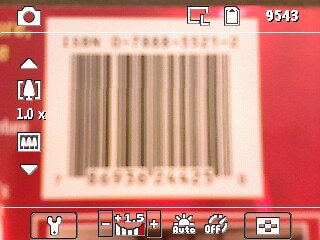
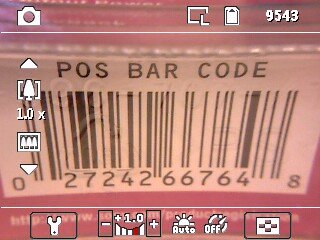
These 2 pictures demonstrate how a special lens is still required in order to scan a 1d code.

I was able to see a new PWC company that can read 1d (and 2d) codes without a special lens attachment. Stay tuned.

Friday, March 23, 2007

Pondering Primate Off To CTIA Wireless In Orlando

I am headed to the CTIA show in Orlando. If you are on the Physical World Connection Company list or if your company has a Physical World Connection application and want to tell me about it, drop me an email.

CTIA WIRELESS® is the world’s largest technology event dedicated exclusively to wireless, broadband convergence and mobile computing technologies, covering the entire industry from network infrastructure to microprocessors to applications to content to end-user hardware

Trillcode Creates A Unique Physical World Hyperlink

Notice anything different about the 2d code from Trillcode?

I talked about the many functions of a Trillcode before, but they are doing something unique.
Trillcode
Here's another Physical World Connection player that has done something very smart. One of the biggest complaints I hear about PWC is identifying the different codes and the scanning applications.

One of the things that will separate the PWC companies, is when each code is recognizable. BeeTagg offers a unique code and Nextcode's ConnexTo tag can be personalized.

Take a look at PWC player Trillcode and see how they allow a company to place an image or logo inside of the 2d code.

Trillcode allows brands, services to identify their own physical world hyperlinks (2D codes). That is a great selling point for adoption.

Today Lark Computers, a Romanian company, introduced the second version of its Trillcode reader. The new release greatly enhance the maximum content length decoding ability, to reach 210 characters on medium-high-end phones. Also it is the first time when a mobile barcode reader is used to process and send order forms or play melodies. The next version of the reader application will double the currently maximum values.
Trillcode
Mr. Cozmin Tircob, Managing Director of Lark Computers said: "We are looking to embed an entire application inside the barcode. Our future product, currently under development, will benefit from the extended storing capacity of the Trillcode. This will give our barcode another dimension and will allow companies using the Trillcode encoder to build in minutes a customized mobile application and deploy it in a barcode."

The application can be used to briefly present the company, products, services and allow clients to order or send feedback from "one click away". There will be options to receive news or advertisements from the company if a network connection is available.

To download the free Trillcode reader, and see how to create your own Trillcode

Semacode Connects Physical Objects With Camera Phones In Africa

From Foreign Policy
Africa catches up on IT innovation


A Ghanaian software developer is popularizing Semacode , a combination of Internet technology and shoe-leather gumption that he helped create.

Here's how it works: A black-and-white barcode is printed up and affixed to buildings, street lamps, or other landmarks. When people walk by and wonder, "Hey, what's that clock tower?" they can just whip out their camera phones and scan the barcode.

Instantly, their Internet-enabled phones tell them they're at the University of Ghana, which was founded in 1948 and has nearly 24,000 students. The idea of using cellphones to read barcodes is not original; Japan has had the technology for years. But in Africa, where streets and buildings are renamed quite often, this tool can be particularly helpful.

Thursday, March 22, 2007

AOL Is Sitting On A Goldmine...But Do They Know It?

Laura Marriott from the Mobile Marketing Association discusses how short codes and text messaging are impacting mobile marketing.

In addition AOL announced a plugin for their instant messenger that reveals IM buddy locations.

I can see AOL, if they use some creative thinking, to become a true mobile player.

Unknown to many, CSCs are the five- or six-digit text messaging (or SMS) numbers marketers provide to consumers so they can interactively engage in a campaign.

Mobile allows brands to connect with their consumers like never before. It gives them the chance to develop a one-to-one dialogue and relationship with consumers anytime, anywhere. CSCs are one way to do exactly this. They allow brands to offer easy-to-use, relevant, entertaining information that ultimately drives consumer action.

Maybe an AOL Yellow Pages ?

Do you think AOL realizes they are sitting on a goldmine

Friday, March 16, 2007

Mobile Philippines Uses Barcodes In March-April 2007 Issue


Mobile Philippines’ March-April 2007 issue is out now with the beautiful Kelly Misa on the cover…again.

We’re definitely not complaining; it’s surely sweeter the second time around with her. Be sure to click on the TMS tag (that’s the barcode on the cover page story; make sure you have the application,it’ll instantly bring you to Mobile’s WAP site where you can view a video clip featuring exclusive behind-the-scene moments with Kelly.

Thursday, March 15, 2007

Microsoft's Lincoln Uses Camera Phone And Images For Mobile Search

Recently Google acquired Neven Vision, and Mobot was acquired in what was called the "marketing wedding of the year". Since then they bought themselves back from acquirer.

Here comes Microsoft with an image recognition search engine application.

Microsoft has their own image recognition application that lets people search the Internet on their cell phones using a camera instead of a keypad.

From Technology Review Microsoft's Lincoln uses images and camera phones for search

Researchers at Microsoft have developed a software prototype called Lincoln that they hope will make Web searches easier. According to Larry Zitnick , a Microsoft researcher who works on the project, phones equipped with the software could, for example, access online movie reviews by snapping pictures of movie posters or DVD covers and get product information from pictures of advertisements in magazines or on buses.

"The main thing we want to do is connect real-world objects with the Web using pictures," says Zitnick. "[Lincoln] is a way of finding information on the Web using images instead of keywords."

Currently, the database contains pictures of DVD covers that link to movie reviews uploaded by Microsoft researchers. However, anyone can contribute his or her pictures and links to the database, and Zitnick hopes that people will fill it with pictures and links to anything from information about graffiti art to scavenger-hunt clues.

The technology is now the basis for the Google Image Labeler , which consists of a game that helps Google serve up more-accurate picture results for keyword searches.

Microsoft now has a speech recognition browser , a barcode scanning device and developing a RFID browser .

Microsoft Buys Speech Recognition Browser TellMe

Microsoft buys a speech recognition browser

When you read this remember that the spoken word is technically a physical world hyperlink. Saying the word "Google" links you to www.google.com. on any device. There are/will be trillions of other physical world hyperlinks that will need a browser.

From USA Today Microsoft buys speech recognition company TellMe

Microsoft announced Wednesday that it is buying privately held speech recognition maker Tellme Networks in a deal believed to be in the range of $800 million.

With the deal, Microsoft gains a company with deep expertise in speech recognition and the intersection of voice and data, an area of keen interest to the Redmond, Wash.-based software giant.

Are we seeing Microsoft transform themselves into a "mobile Internet company"?

Now think about the trillion other physical world hyperlinks (1D code, 2D code, RFID tags, images, fingerprints etc) that will need a browser to connect objects to the Net.

Microsoft already has the browser for the barcodes .

Are they developing an RFID browser ?

Wednesday, March 14, 2007

UpCode Selected As Forum Nokia PRO Member

Physical World Connection player UpCode announced that it has become a member of Forum Nokia PRO, a program that provides advanced technical, business development and marketing support to selected mobile software companies.

Wireless Developer UpCode Ltd. today gains Exclusive Access to Nokia Technical Resources and Business Development Support, joining industry leaders in Forum Nokia PRO.

Forum Nokia PRO provides specialized support for advanced developer companies creating the next generation of software based on the Series 40, S60 and Series 80 platforms from Nokia.

A select number of companies worldwide who demonstrate industry leadership are chosen as Forum Nokia PRO members. By becoming a Forum Nokia PRO member, UpCode Ltd. is better positioned to ensure the close integration of its software with Nokia’s devices and benefits from Nokia’s extensive worldwide software distribution channels.

UpCode Access technology includes a broad range of data collection to the mobile in form of adaptive recognition of Data Matrix, QR, 1D codes, text, pictures, voice and other indicators.

Member companies are also invited to participate in valuable co-marketing activities with Nokia. These can include opportunities to demonstrate applications in Nokia’s booth at industry events and inclusion in Nokia-published software catalogues, distributed to mobile network operators and content aggregators worldwide.

UpCode Ltd. with offices in Finland, London and Shanghai, is the developer of Mobile Access & Interaction (MAI™) technology for mobile phones.

Physical World Connection Helps Combat Counterfeiting

Every prescription drug bottle, or pharmaceutical product will eventually get its own domain (website) and when the 2D code or RFID tag is scanned will connect to the site and verify the authenticity.

The 2D code or RFID tag acts as a physical world hyperlink to the Internet.

Unlike RFID, the 2D barcode matrix can be read by barcode readers that are already widely available in the supply chain.


From in-Pharma Mobile phones call up counterfeits

A twist on an existing security technology will use enhanced mobile phones to help establish the authenticity of pharmaceutical products in developing countries.

The authentication system, developed by UK-based firm Aegate , uses a simple 2D barcode along with a scanner device incorporated into an existing mobile phone. The barcode is scanned by the phone, and is then decoded by Aegate software and a response sent through to the mobile phone confirming or questioning a product's authenticity.

Other examples of pharmaceutical companies combatting counterfeiting.

Tuesday, March 13, 2007

QMCODES A Physical World Connection Player


Add Australian based QMCODES to the list of Physical World Connection companies .

Their story coming shortly.

Microsoft To Acquire TellMe For $800m?

Physical World Connection player TellMe is close to being bought out by Microsoft. TellMe's founder Mike McCue called his vision "DialTone 2.0". That's along the same thinking as giving every physical object a dialtone.

I think it would make a great fit and wonder if Google will counter. Can you see a speech recognition browser in the making? The idea of using words and physical world hyperlinks to connect to the Net.

From C/Net Sources say Microsoft near deal to buy TellMe

Microsoft is close to acquiring privately held Tellme Networks, a maker of products that bridge the worlds of speech recognition and the Internet, CNET News.com has learned.

The deal is expected to be completed and announced later this week, according to sources familiar with the companies' plans.

Mountain View, Calif.-based Tellme is best known for its service that lets people get Internet information over the telephone, but the company also has a variety of services that businesses can use to offer automated data and directory assistance information via the phone
.

Recently they introduced a speech recognition 411 for the mobile.

Who's next on the list to get acquired?

Smart Uses Decodes For SMS Voting

From Denpa Binbining Pilipinas

Physical world hyperlinks being used for SMS voting.


Nextcode's mobile barcode technology being used in a contest done by Smart Communications

Decode, based on a symbology developed by Nextcode (mCode) is scanned and the customer is taken to a reference website, a bill paying process, or in this case ... a vote for a contestant in a beauty contest.

Monday, March 12, 2007

BeeTagg Using PWH For Mobile Marketing And Mobile Search


Physical World Connection player BeeTagg has been making great strides with BeeTaggs for both mobile marketing and search functions.

A couple things I like about BeeTagg. Their code is very easy to identify which gives them a great advantage for mobile marketing. Second, they recognize that a physical world hyperlink (PWH) will be used both as an advertising tool AND a mobile information application.

“We will Rock You” goes BeeTagg: The word famous Rock-Musical from Queen uses BeeTagg in all communication materials in CH, i.e. millions of flyers, thousands of advertising posters covering Switzerland and southern germany, advertisements in bigger newspapers in Switzerland. You can download ringtones, videos and pictures, buy tickets, win travels and tickets and much more.

Searchfox.ch: This is one of the major yellow pages directories in Switzerland. For every company in Switzerland it is now possible to use a BeeTagg to download detailed company information to your mobile.

The BeeTagg is automatically displayed in search results on the searchfox-portal. We think that this is a great example of the reasonable use of 2d-codes on web pages.

Getting the BeeTagg application on a major portal like Searchfox opens the door for both mobile marketing and search applications.

BMW: The BMW Motorcycle Corporation of Switzerland is using BeeTagg to promote their new X-Series Bikes. The BeeTagg is used on many events including Swiss Moto (biggest bike fair in CH), in many communications materials, on stickers and as display at most BMW dealers in CH. Users can download detailed product information, participate in an attractive contest, download videos and more.

Saturday, March 10, 2007

Bar Code Scanning Nextcode Is Hiring

Physical world connection player Nextcode , is looking for a web developer to join their development team in Concord Mass.

Nextcode is a mobile software development firm that specializes in optical barcode reading technology for camera phones. They are a startup company,creating exciting new products that change the way consumers and businesses use mobile phones to access content, buy products, and use mobile services.

They are working with customers throughout the world to introduce innovative mobile services based on our ConnexTo platform.

Qualifications
- 2+ years of experience in web development
- Experience working with web technologies, application servers, databases, optimization & security techniques
- Advanced knowledge of Web services, Java, .Net, C# , AJAX, CSS and HTML and/or Flash
- Ability to work in a dynamic and challenging environment.
- Good team and interpersonal skills
- Strong ambition to tackle new challenges and create solutions accordingly
- Ability to work independently with minimal supervision, tackle new challenges and bring them to completion
- BS or MS in IT related discipline
- Knowledge of basic usability and UI design concepts.
- Candidates must be legally able to work in the US

Contact them at jobs@nextcodecorp.com

Thursday, March 08, 2007

What Google Should Offer With Their Rumored "Switch" Phone

Rumors about Google and Samsung will together build a new mobile phone, codenamed Switch.

Perhaps the most interesting aspect is the rumored go-to-market strategy: Google would build distribution relationships with multiple carriers by allowing them to minimize subscription and marketing costs; that is, Google would market the phone online, and carriers would fulfill.

When I sat down with Larry and Sergey (yes that is a joke) and they asked me what kind of phone Google should build, these are the things I thought would make it a big seller.

1.QWERTY keyboard. Because every mobile phone is/will be connected to the Internet, it only makes sense that the keypad is replaced with a keyboard. It could be a touch pad or keys, but make sure it's QWERTY.

2. Better antenna. Spend a couple extra bucks and build the antenna in the casing allowing a better connection. I would market the phone showing studies of how this is accomplished with new materials.

3. WiFi enabled. Incorporate the ability to switch from cell signal to WiFi. As the adoption of VoIP grows, this is a must.

4. Great battery. In Sprint's Ambassador program, I tested out their Samsung A920 phone using their Power Vision service. I used every high data application they offer and the battery lasted for days.

5. Satellite Radio. I'm not a big fan of carrying my music on my phone, but I do want access to music or TV. With the variety of music and TV channels that sat radio offers, that would do the trick.

6. Camera. Include a camera that produces high resolution pictures and that can capture all types of barcodes (1D or 2D)

7. Toolbar. Put a Google toolbar at bottom of screen so I can type in a quesry and search without having to go online first.

8. GPS When I do a search or pull up a map, I want the phone with GPS function to identify my location without having to type in zip code or city I am in. i realize this isn't a phone issue, but I would like to have it as a buuilt in feature when it becomes available.

9. A universal instant messaging/ SMS "buddy list". One buddy list that I can include my AOL/Yahoo, SMS, text alert/info services, and Skype buddies.

10. Universal email retrieval. A function that allows me to retrieve email from all providers. I realize this is available now, but I want this to be easy to set up.

These are just some things I would love my next "smartphone" to have. I realize some of these ideas aren't possible right now. Keep Apple's iPhone and give me this instead.

Microsoft Uses Barcodes For Text2Paper


Think of this as a physical world hyperlink creating device.

From Seattle Times Microsoft's TechFest

Brier Dudley got a chance to see some of the new products Microsoft is developing. One of them utilizes physical world connection.

Called Text2Paper, the device receives and prints short SMS messages sent from phones onto clear stickers. The labels can then be pasted onto an adjacent paper calendar, on the appropriate day.

The idea is that family members could send appointments, shopping lists and other info to this system, which would most likely be mounted in a kitchen. Each printout also has a bar code that can be read by camera phones, so you can take a picture of an appointment with your phone and have it automatically synced with the device's calendar

Wednesday, March 07, 2007

MarksGuide Reviews Nextcode's Mobile Code Scanning Application

Nextcode's ConnexTo mobile code scanning a snap

ConnexTo , from NextCode, is barcode scanning software that works with camera phones. It can quickly recognize a pattern of dots arranged in rectangular area, which it then translates into data that can be stored or used on your device such as contact details and web addresses, etc. The exciting thing about this is that the scanning works with compatible phones that have a standard 1.3 megapixel camera built in - no other hardware required.

Video of ConnexTo

But This Time It's Different

The Mobile Insider discusses how camera phones that can read 2d codes, and eventually 1d barcodes, will be different than the failed CueCat.

From Mobile Insider The revenge of the Cue Cat

The CueCat was a handheld personal scanning device that was supposed to "inter-activate" print. By reading codes in ads, editorials and flyers, it would pop up corresponding Web pages online. This was supposed to spare us the inconvenience of typing in lengthy URLs and bridge the world of physical and virtual worlds for publishers and marketers.

One U.K. firm, World Forum Research, is stoking the old embers in a new report. With the success of using mobile phones as code readers in Japan and Korea, the company predicts that 70% of U.S. and European consumers will use 2D codes to activate content on their phones by 2009.

These mobile "hyperlinks" will use a visual code, an audio cue or even some sort of touch or proximity signal to pull down to the phone some piece of content or WAP link.

At some point this is going to happen, I have no doubt. But 70% of us using it by 2009?

Handset manuf, wireless providers and packaging companies are already putting the necessary infrastructure in place.

As WFR points out, there are successful trials of the necessary enabling technologies in the U.S., and some systems are already in place in the Asian markets.

The potential here is so monstrous that companies and solutions are just pouring in. That alone is why 2009 seems like an awfully premature target date.

Huh? That statement doesn't make any sense.

I fear the competition and shakeout phase on this one could be huge.

I agree. With all of the players on this list a shakeout is inevitable when Google, Microsoft, Yahoo etc implement a code scanning application for the masses. .

Nokia Introduces Mobile Ad Platform

From ZD Net Nokia introduces mobile ad services

Nokia announced two new services Tuesday to help mobile operators and marketers realize the potential of advertising on mobile phones.

Nokia Ad Service, the first of the new features, is a system for simplifying the mobile-advertising process that supports and manages a full ad campaign lifecycle.

The service is built around a group of content publishers who have formed a mobile-advertising network. It also uses technology developed by Nokia that will be used to deploy, manage and optimize mobile ad campaigns. Nokia Ad Service is launching this week in Europe and will be available globally in the second half of 2007, the company said.

Nokia also introduced Nokia Advertising Gateway, a service for third-party content publishers and advertising aggregators that allows them to deliver targeted advertisements to mobile handsets. The service ties ads to specific multimedia applications like reading digital newspaper content, watching TV, listening to music or looking at directions on maps

Thursday, March 01, 2007

Carnival Of The Mobilists #63


Software Everywhere hosts this week's Carnival of the Mobilists

This week, the theme focused on Mobile Web 2.0 and the Internet of Things. Take a peek at what is probably the weeks best summary of mobile pondering.

Wednesday, February 28, 2007

MediaTek Embeds Scanbuy's 2D Barcode Technology

Yesterday the buzz was about the Mobile Codes Consortium and how mobile players were meeting about how to get Physical World Connection (PWC) adopted. I will have more comments on this in a bit.

Meanwhile, instead of talking about adoption, one PWC player was actually doing it.

This agreement should allow quicker (PWC) adoption from handset manufacturers.

New York, NY, February 28, 2007- Scanbuy, Inc . (www.scanbuy.com), a global provider of wireless commerce solutions, today announced a strategic partnership with MediaTek, Inc., a global leader in consumer and communications IC solutions, to embed Scanbuy 2D barcode technology in MediaTek’s platform marketed to handset manufacturers globally.

MediaTek, a global supplier of wireless communication chipsets and the leading supplier in the greater China market, will offer the Scanbuy barcode technology to all its handsets customers throughout the world. Several key customers are in testing phase already with the technology.

“MediaTek’s global handset customer base makes them an ideal partner,” said Jonathan Bulkeley, Chief Executive Officer of Scanbuy, Inc. “We’re pleased MediaTek is committed to bringing the advanced functionality of our proven barcode-capture technology to their handset partners worldwide.”

“Barcode capturing technology will definitely be an important solution for the mobile world,” said Randolf Wu, Operational Officer of Trilogy Technology. “We’re extremely pleased to form the cooperation partnership between MediaTek and Scanbuy.” Trilogy Technology serves as Scanbuy’s representative in Taiwan.

Serving as a cooperative partner with mainland China's largest cell phone brands, JiChang Hsu, V.P. Wireless Communications BU MediaTek, Inc. said, “We have seen increasing demand from our handset customers for barcode capture technology and we chose Scanbuy as a partner because of their state of the art technology and commitment to customer support”.

Tuesday, February 27, 2007

Denim Code A Physical World Connection Player


Add DenimCode to the Physical World Connection player list .

From ToUBeauty Get a QR code on your jeans

The new French brand Denim Code created interactive jeans that make it possible for the future purchaser to have access to audio-video contents from the clothing.

Thanks to a special free downloadable software, the consumer will be able to capture with his mobile the image of some kind of intelligent bar code embroidered or printed on the clothing, called the tag. He takes a picture of the label that will enable him to watch clips, movies or all kinds of shows

Monday, February 26, 2007

Some Mobile Players Meet On Barcode

From FT.com Mobile Groups Study Barcode Plan (subscription)

Leading mobile communications companies are due to meet in London on Tuesday to consider a plan that would help turn handsets into personal barcode readers – a move that could stimulate the first big mobile-driven advertising market.


While I think it's great that there's some initiative to adopt a specific code and code reading platform, I think the PWC companies that are actually getting their platform adopted by the handets and wireless carriers should have been invited to participate.

Other companies involved in the field say signs of strong consumer adoption of the technology in recent months in Japan and South Korea have stimulated a rash of experiments elsewhere in the world that is likely to make the technology widespread, regardless of the standards push.

In one of the widest-ranging initiatives to date,DuPont last week said it would make 2D codes available on the cans, bottles and many other types of packaging that it supplies to consumer product companies around the world.

I don't think the potential of this licensing agreement has been digested yet.

I explain why here .

Thanks to early work by carriers such as DoCoMo in Japan and China Mobile, “there are already some pretty basic standards that everyone can live by”, said Jonathan Bulkeley of Scanbuy, whose technology is being used by DuPont.

The HP/Publicis group, known as the Mobile Codes Consortium , hoped to reach basic agreements on technology within a year.